Professor Marina Meila has been appointed the Tier 1 Canada Research Chair in Reliable Structure Discovery. Tier 1 Chairs are awarded to outstanding researchers recognized by their peers as world leaders in their fields. Each chair is valued at $200,000 annually for seven years and may be renewed for an additional seven-year term.
In addition to her appointment as a CRC, Professor Meila has received $100,000 in research infrastructure support through the Canada Foundation for Innovation John R. Evans Leaders Fund. The funding will provide computing resources to advance her research program, which focuses on developing mathematically and statistically grounded methods for discovering, validating and interpreting emergent structures in large datasets. The infrastructure includes a single-server system with 224 parallel CPUs organized around 12 TB of shared memory, a configuration designed to support large-scale computation and enable algorithms for reliable structure discovery to process emergent structures in datasets of up to 1 TB.
“Congratulations to Marina on her appointment as the Canada Research Chair in Reliable Structure Discovery,” said Raouf Boutaba, University Professor and Director of the Cheriton School of Computer Science. “The CRC and CFI-JELF support will help advance her innovative research in reliable and interpretable machine learning methods for scientific discovery.”
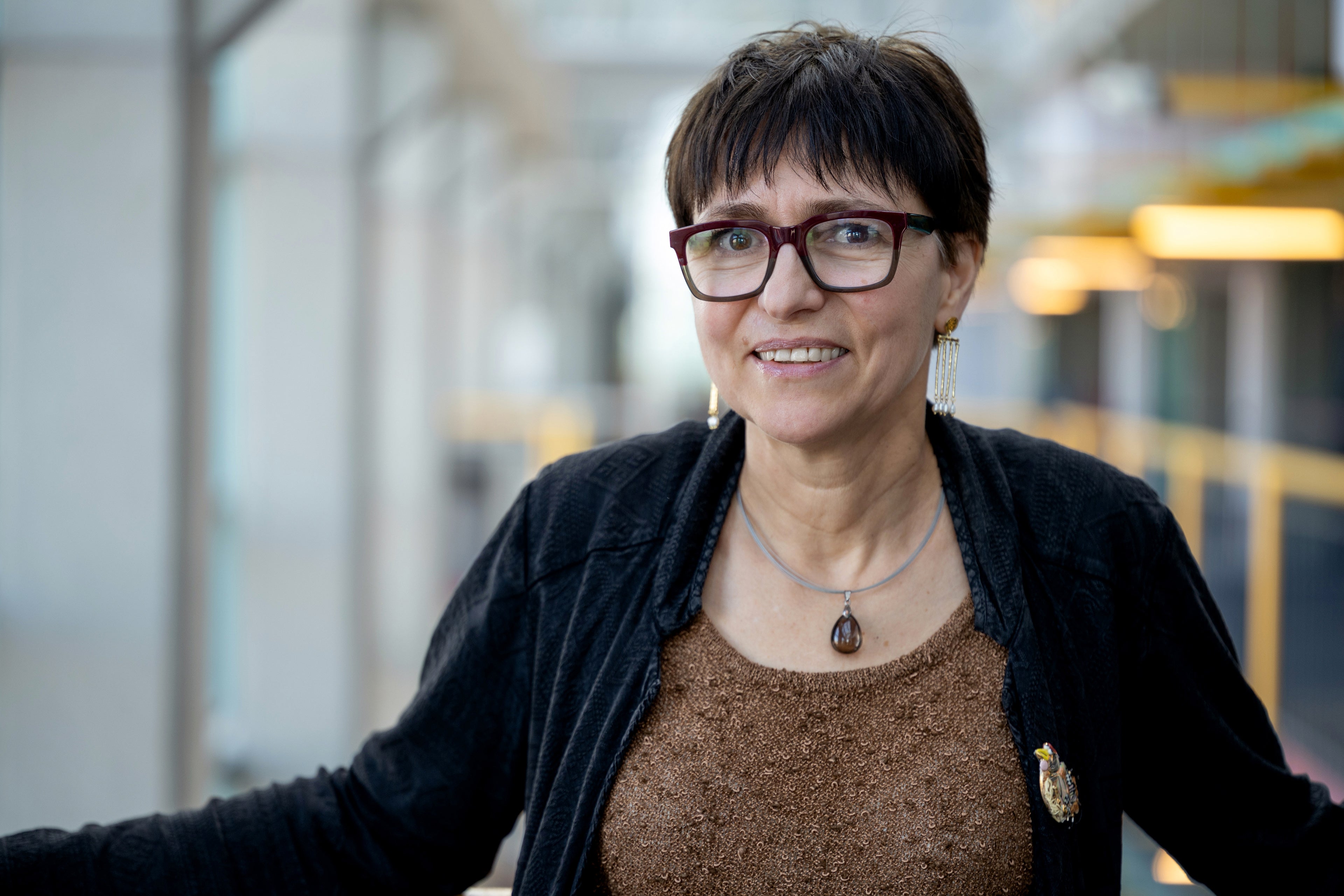
Marina Meila joined the Cheriton School of Computer Science as a Full Professor in July 2025 and was named a Canada CIFAR AI Chair in March 2026. Previously, she was a Full Professor in the Department of Statistics at the University of Washington. She has an MS in Electrical Engineering from the Polytechnic Institute of Bucharest and a PhD in Computer Science and Electrical Engineering from MIT.
About this research
As machine learning becomes increasingly important to scientific discovery, researchers face a growing challenge: distinguishing meaningful patterns in complex data from spurious ones. While machine learning systems can rapidly identify patterns, validating whether those patterns reflect genuine scientific insight often requires tedious expert analyses or additional experiments. Professor Meila’s research will address this challenge by developing rigorous methods to verify and interpret data-driven findings. Her work aims to strengthen the transparency, reliability and rigour of machine learning by creating quantitative approaches to validate, diagnose and interpret structures learned by machine learning algorithms.
As the Canada Research Chair in Reliable Structure Discovery, Professor Meila’s research will focus specifically on developing algorithms that assess the stability of detected patterns and provide geometric and statistical guarantees of correctness for structures discovered from data with minimal expert intervention. The research will also explore how machine learning systems can expand beyond pattern detection to validation and interpretation in ways that align with scientific knowledge and domain-specific constraints.
By automating key aspects of validation, the work will reduce reliance on costly experiments, free researchers from evaluating overwhelming numbers of potential hypotheses, help prevent false discoveries, and translate complex structures into scientifically meaningful insights.
The research will also investigate methods to connect data-driven models with higher-level scientific concepts from chemistry, materials science, molecular biology, and astrophysics. The research ultimately will strengthen the reliability and transparency of machine learning, accelerating the path from data to knowledge while supporting more trustworthy science across disciplines.
Government of Canada’s research ecosystem
The awards are part of the federal government’s investment of more than $168 million in research funding. As a partner in the Canada Research Chairs Program, the Canada Foundation for Innovation is investing more than $5.8 million through the John R. Evans Leaders Fund to support 25 research infrastructure projects at 16 institutions.
In total, six Waterloo researchers were announced as new and renewed Canada Research Chairs, representing an investment of $6 million.