Professor Ian Goldberg has been named a 2026 Fellow of the Royal Society of Canada, the nation’s highest honour bestowed upon scholars, artists and scientists. He is among 105 newly elected Fellows nationwide and one of seven Waterloo researchers elected this year in recognition of their exceptional scholarly, artistic and scientific achievements.
“Congratulations to Ian on being named a Fellow of the Royal Society of Canada,” said Raouf Boutaba, University Professor and Director of the Cheriton School of Computer Science. “Ian is a world-renowned researcher in privacy-enhancing technologies. His research has been incorporated into commercial and open-source products, helping millions of people around the world preserve their security, safety and autonomy online, while protecting themselves against Internet surveillance and censorship.”
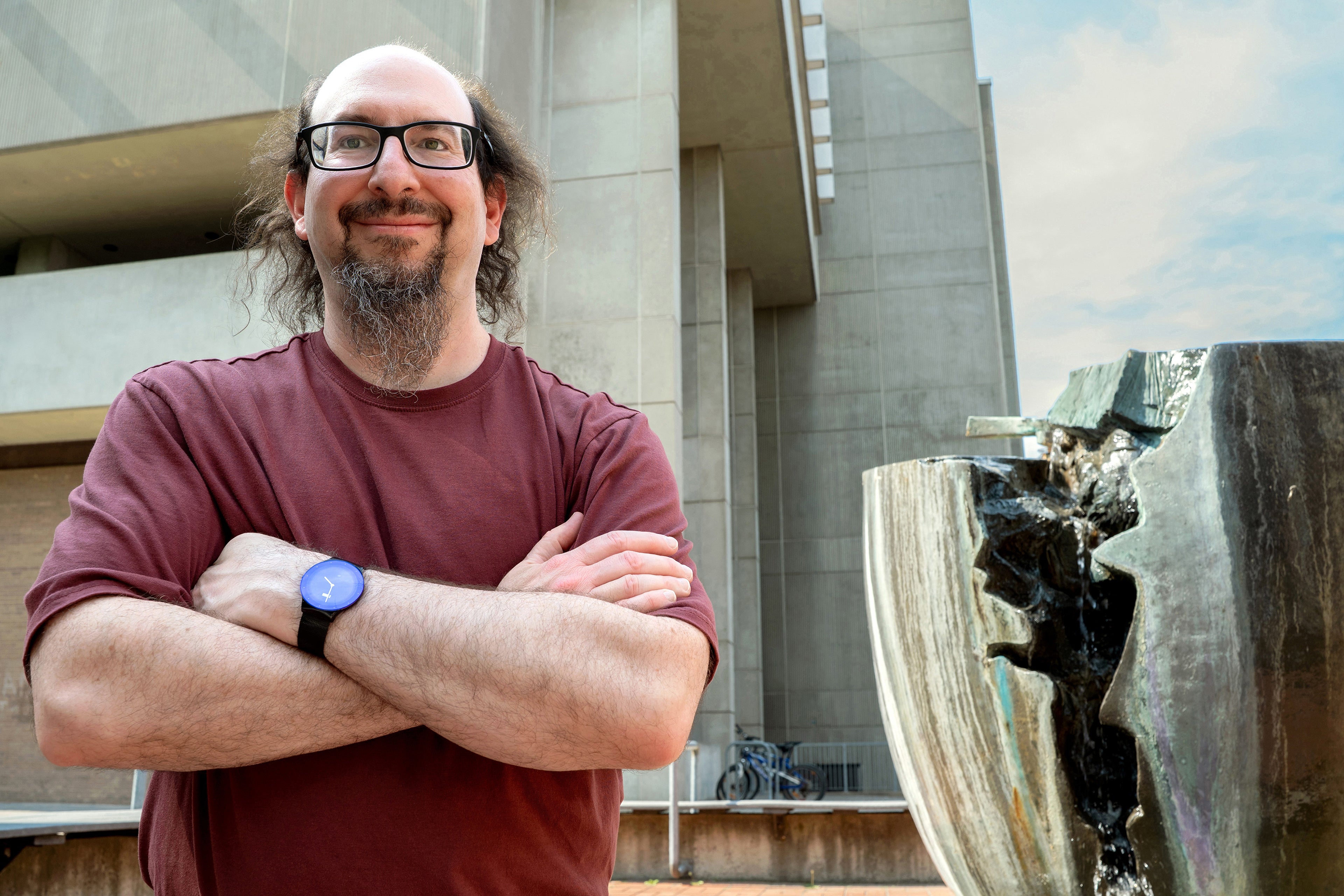
Ian Goldberg is a Professor at the Cheriton School of Computer Science and the Canada Research Chair in Privacy Enhancing Technologies, a position he has held since 2019. He was named a Fellow of the Association for Computing Machinery and a Senior Member of IEEE in 2023. His research has received numerous distinctions, most notably the USENIX Security Test of Time Award in 2019, the Caspar Bowden Award for Outstanding Research in Privacy Enhancing Technologies in 2018, and the 2025 Asiacrypt Test-of-Time Award for introducing the first constant-size polynomial commitment scheme, which has become a cornerstone of modern succinct zero-knowledge proofs. Professor Goldberg is the only researcher whose papers with students have received the Andreas Pfitzmann Best Student Paper Award three times, in 2013, 2018 and 2023, at the Privacy Enhancing Technologies Symposium.
He received the Electronic Frontier Foundation’s Pioneer Award and the Outstanding Young Computer Science Researcher Award from the Canadian Association of Computer Science in 2011. In 2010, he received both an Ontario Early Researcher Award and an Early Researcher Award from CS-Can | Info-Can.
Professor Goldberg’s research
Professor Goldberg is a world leader in privacy-enhancing technologies, a field in which he has worked for more than 25 years. Privacy is an expectation people hold in high regard, yet providing protections in practice is far more complex than many realize. The rise of data lakes and artificial intelligence, combined with increasing computing power, has made protecting privacy more challenging than ever. At the same time, government interest in collecting and using data, for questionable purposes even in democratic countries, is greater than ever. Through a series of groundbreaking innovations, Professor Goldberg has helped strengthen privacy protections for people around the globe.
The top research venue dedicated to privacy-enhancing technologies is the Proceedings on Privacy Enhancing Technologies (PoPETs), formerly known as the Privacy Enhancing Technologies Symposium (PETS). Professor Goldberg has published extensively in this venue, with 25 papers since 2007, along with over 30 papers in leading security and privacy venues since 1996. In total, he has authored more than 115 peer-reviewed publications, 42 of which have been cited more than 100 times according to Google Scholar, including three papers with more than 1,000 citations each. Based on DBLP and CSRankings data, he has long been ranked as a top researcher in Canada in security and privacy publications and is the world’s most prolific author in PoPETs/PETS.
Professor Goldberg is widely known for his research in secure and private messaging, privacy-preserving communications networks, private computation, and censorship resistance. His contributions span the full research spectrum, from mathematical foundations and protocol design to systems implementation and deployment. The privacy-enhancing technologies he develops help protect personal autonomy online for people living in both democracies and restrictive regimes.
A number of Professor Goldberg’s innovations have been widely adopted. He was the lead researcher and developer of Off-the-Record (OTR) Messaging, which brought encrypted messaging to Internet users in 2004. As the first widely deployed desktop instant-messaging system to provide strong privacy protections, OTR was used by hundreds of thousands of people. In 2010, TextSecure, later renamed Signal, adapted OTR protocols for mobile asynchronous messaging. Signal has since become the most widely used secure messaging protocol, deployed in services, including WhatsApp, Facebook Messenger and the Signal messaging app itself, and used by more than one billion people.
From his 2000 PhD thesis to his award-winning Lox paper in 2023, Professor Goldberg has seen many of his contributions to privacy-preserving and censorship-resistant communications networks deployed. In the early 2000s, his work formed the foundation of the Freedom Network, the first commercial service to offer strong privacy-preserving Internet access, where he served as Chief Scientist at a Montreal-based startup. He later made significant contributions to the open-source Tor network, which helps protect the privacy and security of millions of users worldwide. He also served as Chair of Tor’s Board of Directors for 10 years.
Many people live in countries where the Internet is heavily censored. Professor Goldberg’s research on censorship-resistance technologies allows them to access the free and open Internet. His works on Telex (2011) and Slitheen (2016 to 2021) allow people in censored countries to access websites with the help of a cooperating internet service provider outside the country. To the government censor, it appears that the user is accessing an innocuous website, while the provider covertly redirects the user’s traffic to the desired censored website. His Lox software similarly helps people in censored countries to surreptitiously access the Tor network and, from there, the open Internet. Lox is currently being enhanced by The Tor Project for deployment to Tor’s users. Millions of people who rely on Tor to circumvent censorship and surveillance benefit directly from Professor Goldberg’s research.
Professor Goldberg’s award-winning Privacy Pass work aims to reduce the widespread use of CAPTCHAs. It does so by having one party that can verify a user with, say, a single CAPTCHA challenge or by device-based verification, and then issue anonymous cryptographic tokens that can then be redeemed at websites to bypass CAPTCHAs. As the tokens are issued using cryptography, it ensures they cannot be used to track people around the Internet. This work has been formalized through an Internet Request For Comments document, the primary mechanism for standardizing Internet technologies, and is available commercially as Apple’s Private Access Token feature in iOS 16 and macOS Ventura.
Professor Goldberg is also widely known for his contributions to private computation, where computation involving private data can be performed without the parties performing the computation being able to see the private data. Private computation helps prevent the kinds of large-scale data breaches seen almost daily, as companies would be able to perform the computations they want without being able to access the underlying unencrypted data. As they do not have access to the data themselves, the risk of that data being stolen is significantly reduced.
Professor Goldberg has worked on a variety of aspects of private computation, including private information retrieval (2007–2022), trusted execution environments (2019–2025), and multiparty computation (2007–2024), including the multiparty digital signature scheme FROST (2020). FROST has been formalized as an Internet Request For Comments document and incorporated into a number of commercial and open-source blockchain products. Professor Goldberg’s seminal polynomial commitment scheme with Aniket Kate and Greg Zaverucha, known as KZG10 and named after the surnames of its authors, has become foundational to modern cryptography, private computation and cryptocurrency systems. The work received the 2025 Asiacrypt Test-of-Time Award in recognition of its enduring impact on cryptographic theory and practice.
Professor Goldberg’s research has also been featured in major media outlets, among them The Atlantic, The Globe and Mail, and in two front-page articles in The New York Times. He has delivered three keynote addresses and four distinguished lectures across Canada, the United States and Europe.
Through sustained and influential contributions to computer privacy, Professor Goldberg has helped shape the technologies that protect billions of online communications worldwide. His research has advanced both the theory and practice of privacy-enhancing technologies, producing innovations that have been widely adopted and internationally recognized. Every day, countless people benefit from stronger privacy, enhanced security and freer access to information because of the technologies he has created.
Fellows of the Royal Society of Canada at the Cheriton School of Computer Science
In 2026, two faculty members from the Cheriton School of Computer Science were elected Fellows of the Royal Society of Canada. With the election of Professors Jimmy Lin and Ian Goldberg, the number of Cheriton School faculty members who have been named Fellows of the Royal Society of Canada increases to 14.
Previously elected Fellows are Professors N. Asokan, Shai Ben-David, Raouf Boutaba, Richard Cleve, Ihab Ilyas, J. Alan George, Srinivasan Keshav, Ming Li, Renée J. Miller, J. Ian Munro, M. Tamer Özsu, and Douglas Stinson.
Royal Society of Canada
Founded in 1882, the RSC comprises the Academy of Arts and Humanities, Academy of Social Sciences, Academy of Science, and the RSC College. The RSC recognizes excellence, advises the government and society, and promotes a culture of knowledge and innovation within Canada and with other academies around the world.