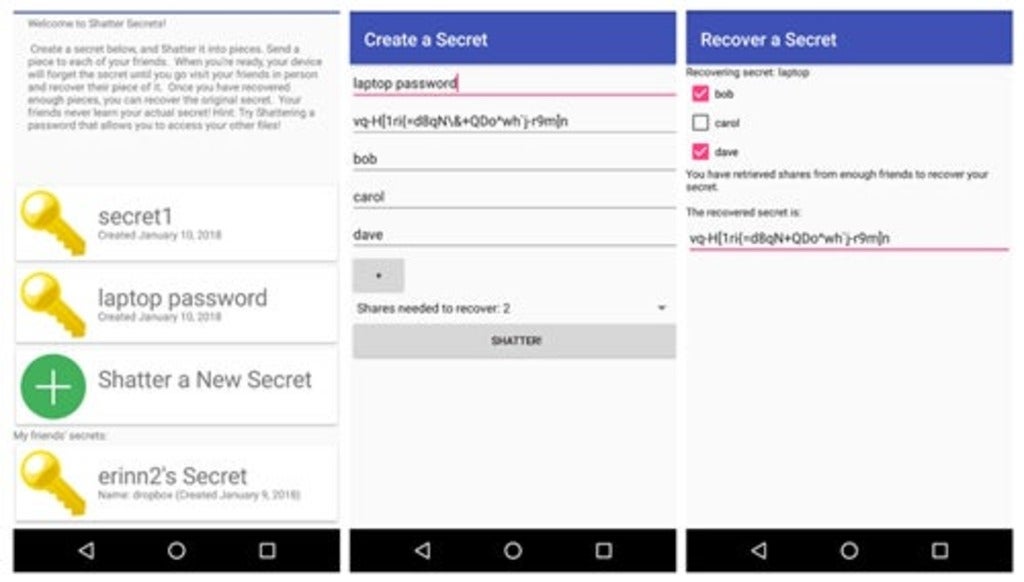
App will protect confidential data when crossing borders
Computer scientists at the David R. Cheriton School of Computer Science have found a novel method to help travellers protect sensitive information from border control agents.
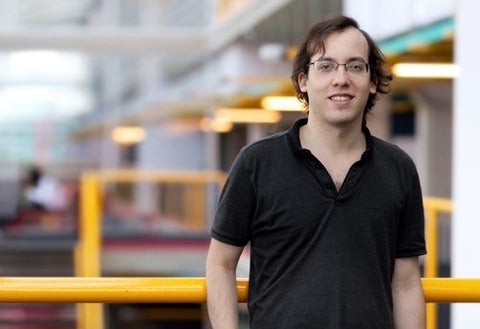
Nolen Scaife, PhD candidate
Florida Institute for Cybersecurity, University of Florida
Credit, debit, and prepaid cards have dominated the payment landscape for decades, empowering the economy. Unfortunately, these legacy systems were not designed for today's adversarial environment, and deployment of new technologies is slow, expensive, and difficult to adopt.
Brandon Alcox, Master’s candidate
David R. Cheriton School of Computer Science
This thesis investigates the application of various fields of artificial intelligence to the domain of sports management and analysis. The research in this thesis is primarily focused on the entry draft for the National Hockey League, though many of the models proposed may be applied to other sports and leagues with minimal adjustments.
Anthony Anthony, Master’s candidate
David R. Cheriton School of Computer Science
Noah Murad, Master’s candidate
David R. Cheriton School of Computer Science
David Lepofsky, LLB, Osgoode Hall Law School, LL.M, Harvard Law School
Chair, Accessibility for Ontarians with Disabilities Act Alliance
Adjunct Professor, Osgoode Hall Law School
Christian Gorenflo, PhD candidate
David R. Cheriton School of Computer Science
Blockchain technologies are expected to make a significant impact on a variety of industries. However, one issue holding them back is their limited transaction throughput, especially compared to established solutions such as distributed database systems.
Professor Shalev Ben-David completed his PhD at MIT in 2017 under the supervision of Scott Aaronson. He joined the David R. Cheriton School of Computer Science as a faculty member in the summer of 2018 after completing a postdoctoral fellowship at the University of Maryland.
Learn more about his research and where he sees it heading.
Matthew Amy, PhD candidate
David R. Cheriton School of Computer Science
The design and compilation of correct, efficient quantum circuits is integral to the future operation of quantum computers. This thesis makes contributions to the problems of optimizing and verifying quantum circuits, with an emphasis on the development of formal models for such purposes. We also present software implementations of these methods, which together form a full stack of tools for the design of optimized, formally verified quantum oracles.