Seminar • AI Institute — AI and ML at Thomson Reuters
Khalid Al-Kofahi, Head, Corporate R&D, Center for AI and Cognitive Computing
Thomson Reuters

Khalid Al-Kofahi, Head, Corporate R&D, Center for AI and Cognitive Computing
Thomson Reuters
Back in 2016, on a sticky late-August day, a guy named Mark walked through the streets of Yaba, a historic neighbourhood in Lagos, Nigeria. He was keeping it low key. Just a few handlers and security guards sweating buckets in the heat as they all made the two-kilometre journey on foot.
Nabiha Asghar, PhD candidate
David R. Cheriton School of Computer Science
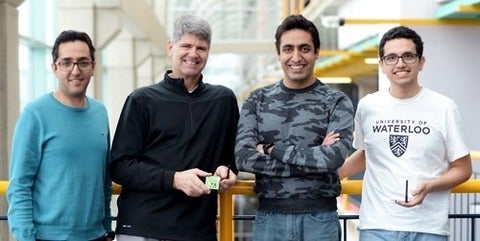
Making your house “smart” could soon become cheaper and easier, thanks to new technology developed by researchers at the David R. Cheriton School of Computer Science.
Their recent study describes an approach that can be used to deploy, for the first time, battery-free sensors in a home using existing WiFi networks. Previous attempts to use battery-free sensors ran into some obstacles, making the efforts impractical. These hurdles include the need to modify existing WiFi access points, challenges with security protocols, and the need to use energy-hungry components.
Andrew Delong, Head of Computational Research
Deep Genomics
Genomics focuses on the sequences in our genomes and how they encode for function in our cells. Predicting how sequences will be interpreted by the cell is important for identifying disease-causing mutations and for designing therapies.
Maura R. Grossman is a Research Professor and Director of Women in Computer Science at the David R. Cheriton School of Computer Science, as well as an eDiscovery attorney and consultant in Buffalo, New York.
Saba Alimadadi, Postdoctoral Researcher
Northeastern University
Program comprehension is crucial in software engineering, a necessary step for performing many tasks. However, the implicit and intricate relations between program entities hinder comprehension of program behaviour and can easily lead to bugs. It is particularly challenging to understand and debug modern programming languages such as JavaScript, due to their dynamic, asynchronous, and event-driven nature.
Helge Rhodin, Computer Vision Laboratory
Ecole polytechnique fédérale de Lausanne
Cheriton School of Computer Science Professor Bin Ma has received $462,998 in research support from Genome Canada for an ambitious three-year project titled “Software for peptide identification and quantification from large mass spectrometry data using data independent acquisition.”
Adam Schunk, Master’s candidate
David R. Cheriton School of Computer Science