PhD student Yuzhe You showcased her AI-powered design prototype at Adobe Summit 2026, held in Las Vegas from April 19 to 22.
Adobe Summit is the world’s largest digital experience conference. Every year, Adobe gathers 16,000 attendees, ranging from industry leaders, marketers and data analysts, to “share ideas and best practices around customer experience management.”
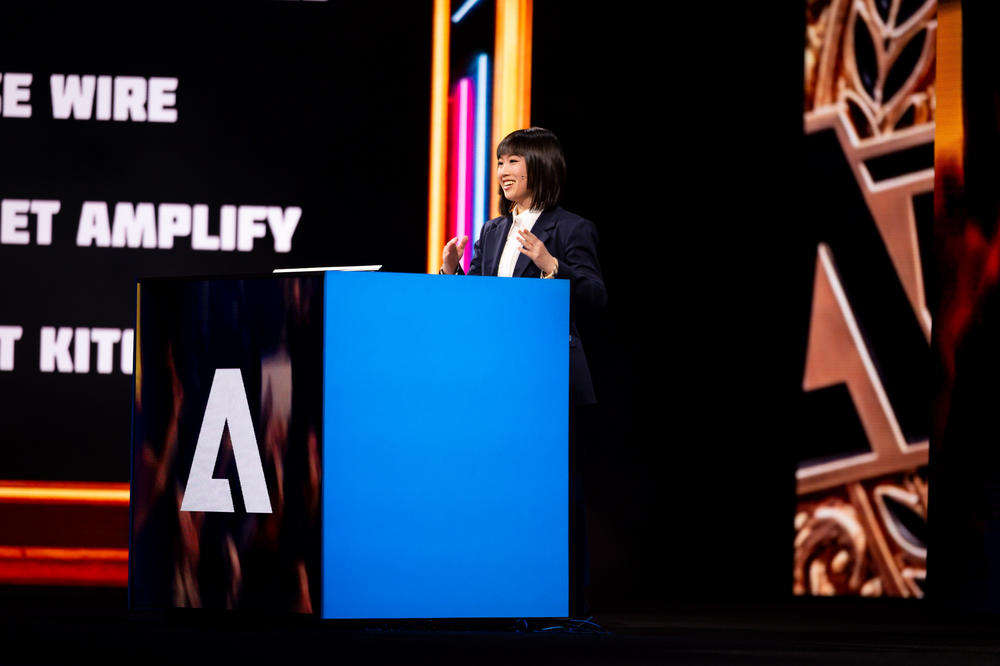
Yuzhe You at the 2026 Adobe Sneaks
This year’s theme was “Agentic Era,” focusing on how organizations can leverage AI-native platforms and autonomous AI agents to scale content production, enhance personalized customer care, and drive business growth.
Adobe Sneaks, a fan-favourite event at Adobe Summit, highlights bold, experimental projects from Adobe’s research and engineering labs, some of which later become products. This year, only seven sneaks were selected among 500 submissions.
“I am very proud of Yuzhe and thrilled that her research was selected,” says her supervisor, Professor Jian Zhao. “She spoke about her Adobe internship work, Project Test Kitchen, which introduces a flexible image-generation interaction model for designers. I would also like to thank Adobe for donating $20,000 USD to support this line of research on AI-assisted graphic design at my lab. This generous support also highlights the importance of strong collaborations between industry and academia in advancing innovative research, translating ideas into real-world impact, and training the next generation of talent.”
2026 Adobe Sneaks was hosted by actress and comedian Iliza Shlesinger.
“It was such a surreal experience as a research intern to showcase my work in front of thousands of people,” says Yuzhe. “Seeing the audience’s reactions to my Sneak was super exciting, and it meant a lot that Iliza enjoyed it as well. I’m incredibly grateful for this opportunity and for the support from my Adobe mentors, my supervisor, and the entire Sneaks team. Getting to personally meet Adobe CEO Shantanu Narayen backstage — and share a fist bump — was a moment I won’t forget!”
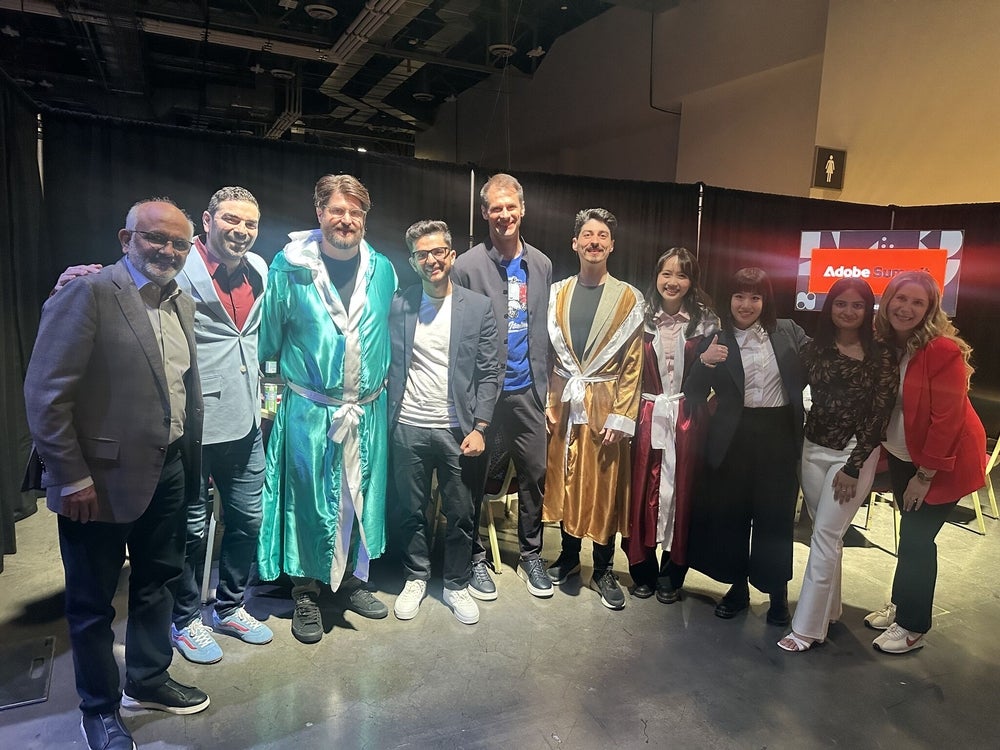
Yuzhe (third to the right) backstage with her fellow Sneaks presenters alongside Adobe CEO, Shantanu Narayen (far left)
Yuzhe opened her demo with a prompt: imagine collaborating on an illustration with your team. While everyone may share a common vision, each pictures it a little differently. While using an AI image generator, you try to capture everyone’s ideas into a single prompt. Yet, the resulting image doesn’t capture everyone’s vision.
Instead of relying on a single, precise prompt, what if an AI tool could embrace multiple viewpoints at once? Something that reflects the real-life design process, where the vision is ambitious yet ambiguous, ideas are constantly changing, and the team atmosphere is dynamic.
Yuzhe encompasses these concepts into her prototype, Project Test Kitchen. When users open the app, they are met with nine empty image slots. On the left is a mood board, where they can upload images. If their product has a specific brand identity, such as a logo or colour palette, they can upload and pin these images, which are then incorporated into the generated graphic. The team members can also define the art style of images, such as minimalistic or futuristic, and composition. Once they’re done, an AI agent will analyze the mood board, the art style and composition to generate nine unique posters.

Before and after example of Project Test Kitchen, where a team created nine unique posters using a mood board featuring two design backgrounds, a goose singing into a microphone and the Adobe logo. The latter is pinned, which signals Project Test Kitchen to incorporate the logo in all the posters.
The team can iteratively design the generated posters. For example, they can modify it by adjusting its composition and art style, such as changing the colour palette. If they want to explore one of the graphics further, they can drag it to the mood board and hit the “extract” button. This feature will break down the design’s core ideas into “reusable building blocks.” Suppose one of the graphics’ building blocks includes an illustration of a cherry blossom. If a user drags the block to one of the other pieces, it will incorporate the cherry blossom.
The app also allows users to submit a sketch. The AI agent will integrate it — either the sketch itself or its concept — into the posters. In this way, Project Test Kitchen provides a flexible landscape for brainstorming, collaboration and creative exploration.
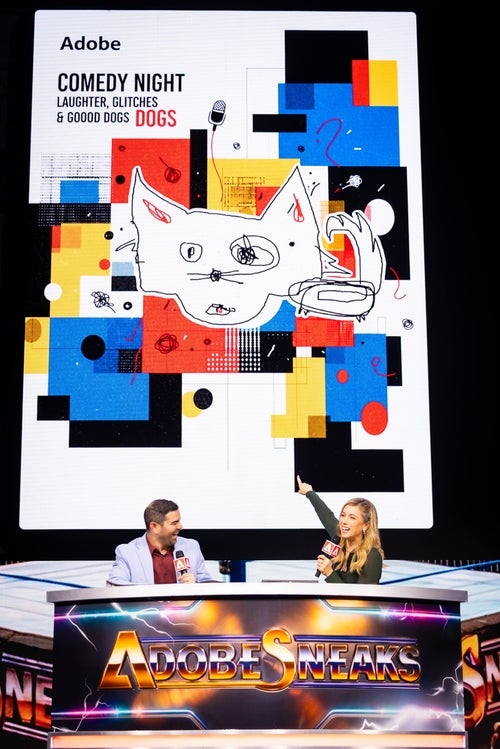
During the demo, Iliza submitted a sketch of her dog, Tian Fu, which was integrated into the posters.
The app also allows users to submit a sketch. The AI agent will integrate it — either the sketch itself or its concept — into the posters. In this way, Project Test Kitchen provides a flexible landscape for brainstorming, collaboration and creative exploration.
Users can try out Project Test Kitchen on Adobe's website.
Project Test Kitchen was born out of Yuzhe’s internships at Adobe’s Experience and Evaluation Lab in both San Jose and Toronto. These labs focus on agentic support for creative design, which aligns with her career trajectory. As a teenager, Yuzhe aspired to be an artist and attended the prestigious Rhode Island School of Design’s pre-college program. It wasn’t until she took a programming class in her senior year of high school that she discovered computer science could expand her creativity.
Her PhD research focuses on using interactive visualizations, mainly gaming principles, to make AI more understandable and accessible for non-technical users. This game-changing plan received $145,000 from various scholarships and funders.
By blending creative fields from gaming to art, Yuzhe’s “research palette” is making technology more accessible and interactive for everyday users.