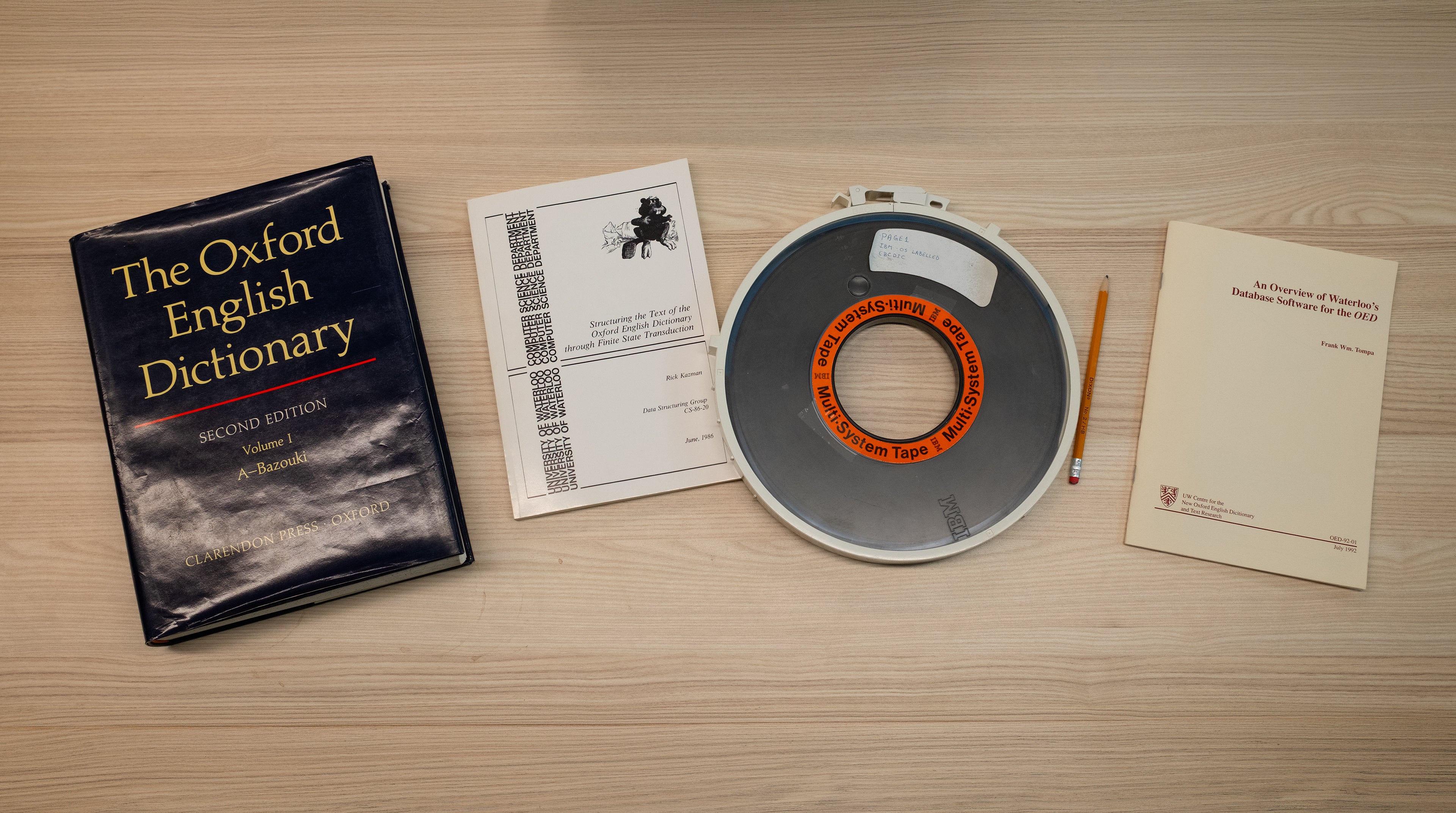
In an age of search engines, online databases, and AI assistants, it is easy to forget that for most of modern history research was done using books, paper, and pencils. If you have ever looked up a definition or searched the etymology of a word online instead of driving to the library, you have the Waterloo innovators behind the New Oxford English Dictionary Project to thank.
When the original Oxford English Dictionary — the largest and most comprehensive history of the English language ever created — was published in 1928, it was the result of more than 70 years of collective effort. Researchers had begun collecting historical examples of word use in 1857. In the decades that followed, more than 800 volunteers collected millions of quotations, which they wrote out by hand on slips of paper.
Between 1884 and 1928, Oxford University Press (OUP) published 125 small books containing definitions as they finished them, which they then collected into a 12-volume set containing more than 400,000 definitions. There was just one problem: the dictionary had taken so long to assemble that it was already out of date! By 1933, OUP published the first of four eventual supplements containing new words: users would have to look up a word in the original dictionary, then check the supplement separately if they couldn’t find it.
In the 1980s, the publishers at OUP decided it was time to create a second, complete edition of the Oxford English Dictionary — ideally in less than seventy years. That’s where the cutting-edge Department of Computer Science at the University of Waterloo came in.
Read the full article on Waterloo News.