When Armaan Gupta, a University of Waterloo computer science student, launched watched.earth after a weekend of development, he expected it to be a fun side project. Within a week, the platform had attracted more than 1.1 million visits and drawn attention from the global technology community.
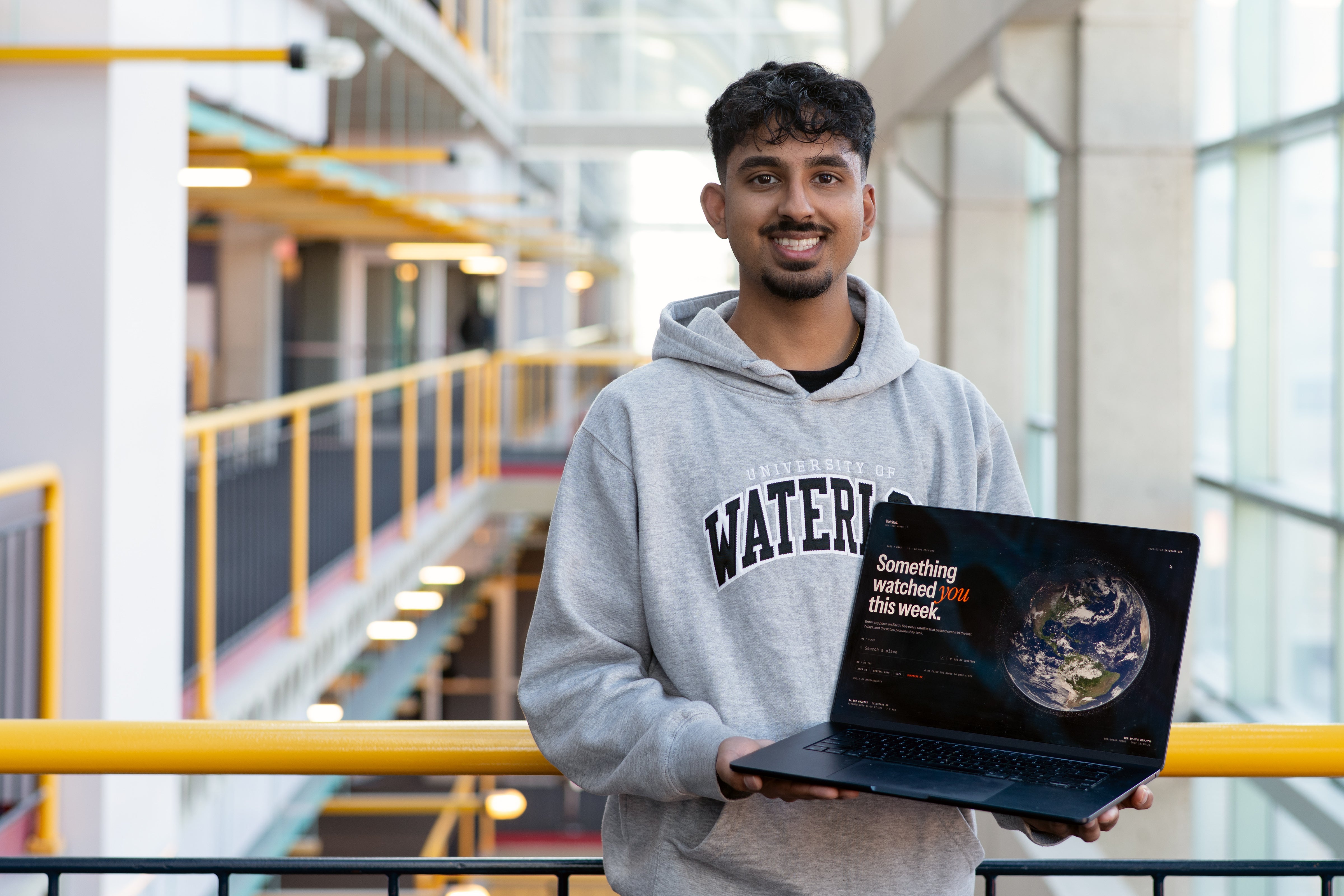
Armaan Gupta, a University of Waterloo computer science student, displays the landing page of watched.earth, the satellite imagery platform developed in less than 48 hours that attracted more than 1.1 million visits within its first week.
watched.earth allows users to choose any location on Earth and see which satellites passed overhead in the previous seven days, along with publicly available imagery captured during those passes. The platform tracks about 400 imaging, weather, radar and crewed satellites using data from public sources including Sentinel-2, Landsat and NASA archives. It also lets users replay satellite passes and create timelapses showing how locations have changed over time.
A member of the class of 2029, Gupta developed the project after realizing that most people are unaware of how much satellite imagery is publicly available and how difficult it can be to access.
"I realized the general public had no idea that there are thousands of satellites out there potentially taking photos of your area every day and a lot of those photos are made public," Gupta said. "Current ways to access those photos are way too complicated. I wanted to make it easy to see for yourself."
Designed to make satellite data more accessible, the platform performs orbit calculations directly in the user's browser and does not require an account. According to Gupta, most users are simply curious about what satellites can see, while others use the site to explore environmental change, track ice loss or better understand events taking place around the world.
The project also highlights how computer science can be used to make complex information more understandable and accessible to the public.
Gupta built watched.earth independently in less than 48 hours and released it as open-source software under the MIT licence. The platform's rapid growth provided an unexpected lesson in scaling software systems and managing demand on the public data sources that support the service.
Despite receiving offers to purchase the platform, Gupta says his immediate focus remains improving the quality of the imagery available through the site.
"I don't have any plans to monetize it yet," Gupta said. "My number one goal is to improve resolution on the photos."
For Gupta, watched.earth remains a passion project motivated by a desire to help people better understand the technologies orbiting above them and the vast amount of information already available from space.
Listen to Armaan Gupta's conversation with Craig Norris about watched.earth on CBC Radio.