Professors Pascal Poupart of the Cheriton School of Computer Science and Luis Ricardez-Sandoval of the Department of Chemical Engineering have received $480,000 to strengthen Canada’s supply of critical minerals by applying artificial intelligence to the recycling of rare earth elements.
The four-year project, Advanced Reinforcement Learning Strategies for Optimal Process Flowsheet Design in the Recycling of Rare Earth Elements, will use reinforcement learning to design more efficient, sustainable recycling systems. The research is supported by $216,000 from the Bank of Montreal and $264,000 from Mitacs, and will provide training opportunities for four PhD students and one master’s student.
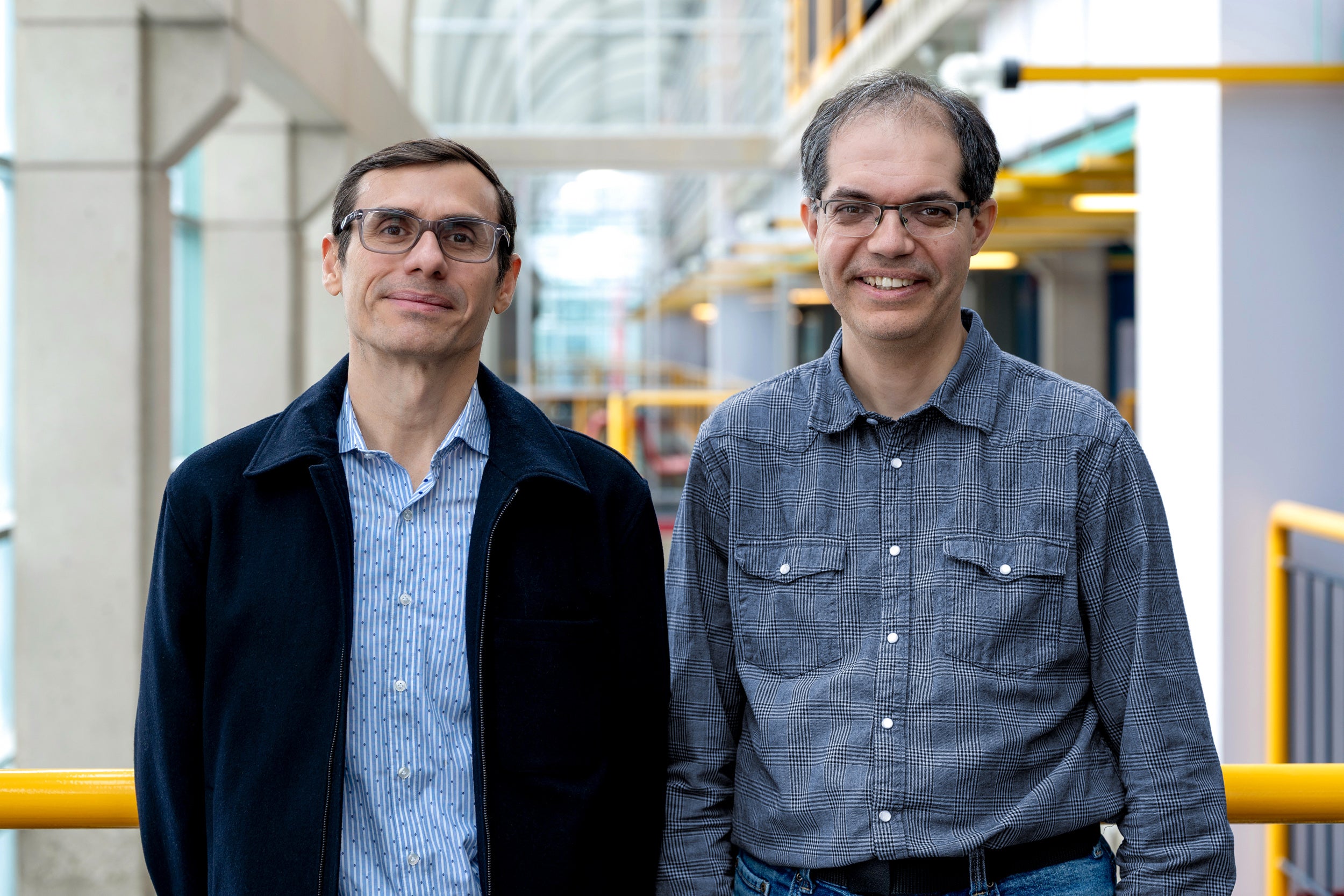
Left to right: Professors Luis Ricardez-Sandoval and Pascal Poupart
Luis Ricardez-Sandoval is a Professor in the Department of Chemical Engineering and the Tier II Canada Research Chair in Multiscale Modelling and Process Systems. His research group develops novel theoretical and computational tools that analyze, describe and predict the behaviour of complex chemical materials, processes and systems. The group has specific expertise in advanced CO2 capture technologies and energy systems, process intensification, computer-aided design for heterogeneous catalysis, and the development of advanced machine learning strategies aimed at improving the design, operability and sustainability of chemical and manufacturing systems, in particular those that evolve at different time and length scales (i.e., multiscale systems).
Pascal Poupart is a Professor at the Cheriton School of Computer Science, a Canada CIFAR AI Chair at the Vector Institute, the research director of the Vector Institute, and a member of the Waterloo Data and AI Institute. His research focuses on developing algorithms for machine learning with application to natural language processing and material design. He is best known for his contributions to the development of reinforcement learning algorithms. Notable projects include Bayesian federated learning, probabilistic deep learning, data-efficient reinforcement learning, inverse constraint learning, reward-guided text generation, agentic workflow adaptation and validation, multi-agent coordination, multi-agent LLM orchestration safety and dynamic composition of image generation models.
More about this research project
Canada’s approach to critical minerals aims to leverage the country’s resource potential to strengthen national security, generate economic growth, and position Canada as a key partner in global supply chains for clean energy. Demand for rare earth elements, critical components in batteries, semiconductors and many modern technologies, from electric vehicles to smartphones, is expected to grow significantly in the coming years.
Although recycling technologies for rare earth elements exist, many are designed using heuristics and engineering principles that may not fully account for long-term sustainability, economic trade-offs or the uncertainties inherent in complex chemical processes. As a result, rare earth elements are still rarely recycled. Barriers include limited collection systems, the difficulty of extracting materials from scrap, and the low concentration of rare earth elements in most end-of-life products.
Given a user-defined end-of-life waste feed-stream and a desired group of rare earth elements to recover from that stream, can economically attractive, sustainable and technically viable recycling process flowsheets be identified that optimize performance and operations? To answer this question, the research team led by Professors Ricardez-Sandoval and Poupart will develop, test and validate advanced reinforcement learning strategies tailored to design novel chemical recycling processes for rare earth elements.
The project will focus on designing constrained reinforcement learning that considers operational limits, along with partially observable and Bayesian reinforcement learning to manage process dynamics and uncertainty in model parameters. To allow solutions developed for one recycling process to be transferred to others, the researchers will design techniques for domain adaptation, transfer learning, multi-task learning and foundation models.
By integrating AI-driven optimization with chemical engineering expertise, this multi-disciplinary research group aims to design near-optimal operations management strategies and scalable recycling process flowsheets that improve both performance and sustainability of rare earth elements.
Bank of Montreal will play a key role in the project, contributing technical and managerial insights and participating in internal discussions and public presentations. Insights from this research will enable Bank of Montreal to plan for the future by making informative and strategic decisions. This collaboration will also provide valuable feedback on the proposed frameworks, as well as perspectives on public perception and societal impact. The outcomes of the research are expected to accelerate the commercial adoption of rare earth element recycling systems, strengthening Canada’s position as an emerging leader in sustainable critical mineral technologies.