Valentio Iverson, Alice Moayyedi and Beihao Zhou are recipients of the Computing Research Association’s 2026 Outstanding Undergraduate Researcher Awards, an annual program that recognizes exceptional undergraduate researchers from universities across North America.
All three students received honourable mentions in this year’s competition, placing them among an outstanding group of research-focused undergraduates whose work demonstrates technical depth, originality and intellectual creativity.
“Congratulations to Valentio, Alice and Beihao on receiving honourable mentions from the Computing Research Association,” said Raouf Boutaba, University Professor and Director of the Cheriton School of Computer Science. “Through their publications they have distinguished themselves as exceptional computer science researchers from leading universities across Canada and the United States.”
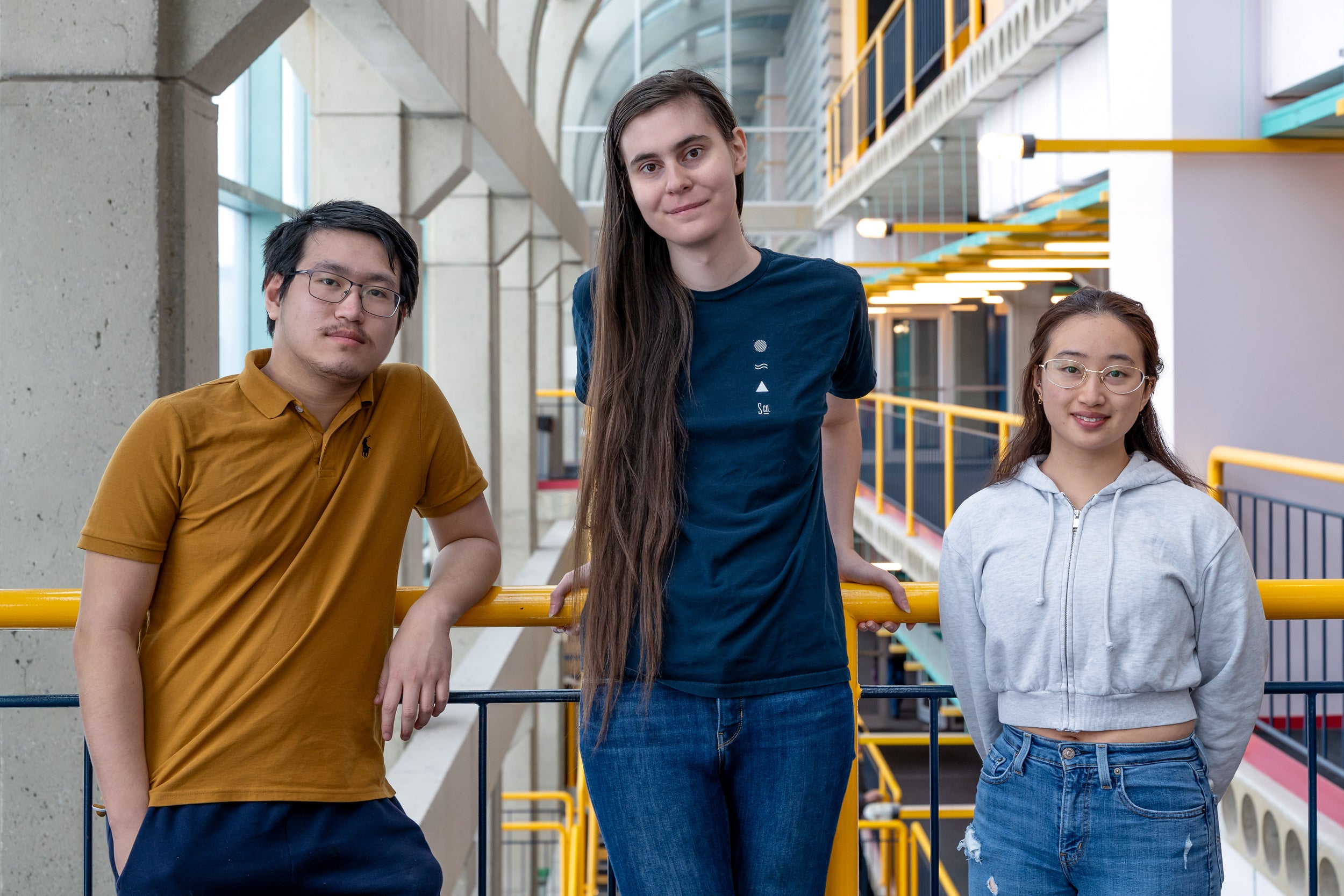
Left to right: Valentio Iverson, Alice Moayyedi, Beihao Zhou
Valentio Iverson’s research lies at the intersection of machine learning and theoretical computer science, with a focus on theoretical foundations of machine learning. More broadly, he is also interested in theoretical computer science and other math topics like number theory, combinatorics and discrete geometry.
Alice Moayyedi’s research focuses on the computational complexity of finding combinatorial objects. She is also interested in information theory, especially as it pertains to statistical inference and games of chance, as well as the development and analysis of algorithms.
Beihao Zhou’s research interests focus on improving the efficiency and scalability of systems for AI and data-intensive workloads. She is particularly interested in scale-out architectures and hardware–software co-design to reduce memory, compute, and energy overheads in cloud and ML infrastructure, with the goal of building practical, production-scale systems for next-generation AI.
Valentio Iverson | Collaboration with Professors Gautam Kamath, Stephen Vavasis and Jerry Wang
Valentio Iverson is a final-year undergraduate student majoring in Computer Science, Combinatorics and Optimization, and Pure Mathematics.
His recent research with Professor Gautam Kamath focused on statistical estimation under the constraint of differential privacy, a rigorous notion of data privacy that prevents the output of a statistical procedure from revealing sensitive information about its input dataset. Differential privacy has been studied extensively for learning statistical models, but such tasks are data intensive to solve. But in many settings, learning a statistical model is often unnecessary, as only a single sample from a distribution needs to be generated.
Previous work showed that this could be done efficiently when the Gaussian covariance matrix is bounded, but it left open whether the same was possible for general Gaussian distributions. Valentio’s work with Professor Kamath and PhD student Argyris Mouzakis resolved this problem by developing the first O(d)-sample algorithm for sampling from general Gaussian distributions. Their paper, Optimal Differentially Private Sampling of Unbounded Gaussians, was presented at COLT 2025, a leading international conference in learning theory.
“Valentio was responsible for helping come up with a solution, formalizing the arguments and determining the appropriate technical details,” said Professor Kamath. “And he carried them out with facility and great clarity.”
Earlier as an undergraduate research assistant, Valentio worked with Professor Stephen Vavasis in the Department of Combinatorics and Optimization on a project that resulted in the paper Mean and Variance Estimation Complexity in Arbitrary Distributions via Wasserstein Minimization. This research explored the computational complexity of estimating the mean and variance in high-dimensional distributions from samples, highlighting a computational barrier between maximum likelihood estimation and Wasserstein distance minimization for parameter estimation.
In his third year, Valentio also collaborated with Pure Mathematics Professor Jerry Wang and PhD student Gian Cordana Sanjaya on a number theory problem that led to a publication titled Squarefree Discriminants of Polynomials with Prime Coefficients.
In addition to his research, Valentio is keenly interested in competition mathematics. His achievements include his placing first in the Indonesia Math Olympiad, winning a bronze medal at the Asia Pacific Math Olympiad, and receiving an honourable mention at the William Lowell Putnam Mathematical Competition. He has also served as an assistant instructor at the Indonesia International Mathematical Olympiad training camp, and he proposed Problem 2 for the International Mathematical Olympiad 2024, the first IMO problem authored by a contributor from Indonesia.
“I have been incredibly impressed by Valentio’s abilities,” said Professor Kamath. “He intends to continue his research career by doing a PhD, and he has my hearty endorsement in that regard.”
Alice Moayyedi | Collaboration with Professor Elena Grigorescu
Alice Moayyedi is an undergraduate student, pursuing a Bachelor of Computer Science degree with a minor in Statistics.
Her research with Professor Elena Grigorescu began with an in-depth study of a recent paper in coding theory due to Shayan Oveis Gharan and Arvin Sahami, which investigated the existence of sparsifiers sets for error-correcting codes. Code sparsification is a notion recently introduced as an analogue to the well-studied notion of graph sparsification.
“Alice read the paper and presented it to me during our second meeting,” recounts Professor Grigorescu. “Despite having no prior background in coding theory, she quickly grasped all the relevant definitions, came up with a thoughtful set of technical questions for clarification, and developed a spot-on intuition about the proof. From then on, I guided her through the process of asking questions and identifying good open problems. By the end of the summer, Alice came up with a sharp understanding of new structural properties of sparsifiers.”
Building on this foundation, Alice proved that vectors supported at complements of optimal sparsifier sets have the largest weight among those closer to the zero codeword than to any other codeword. She and Professor Grigorescu then explored whether such sparsifiers can be found efficiently, an open problem in the graph sparsification setting.
Alice first showed that in fact it is NP-hard to find optimal sparsifiers in the cosets of the code that contain them. She then became fascinated with the more general problem of finding optimal sparsifiers of the entire code. Within a few weeks, Alice found a Turing reduction from the famous Nearest Codeword Problem to the problem of finding optimal sparsifiers. Moreover, she showed that it is hard to even approximate the size of such sparsifier sets.
This work already resulted in a paper titled On the Hardness of the One-Sided Code Sparsifier Problem, which has been accepted for presentation at STACS 2026, the 43rd International Symposium on Theoretical Aspects of Computer Science.
“Alice is a pleasure to work with,” said Professor Grigorescu. “She is intelligent, creative, and has the perseverance needed to pursue research of the highest quality.”
Beihao Zhou | Collaboration with Professors Mina Tahmasbi Arashloo, Samer Al-Kiswany, Sihang Liu and Hong Zhang
Beihao Zhou is a final-year undergraduate student pursuing a Bachelor of Computer Science degree. She has collaborated with four faculty members at the Cheriton School of Computer Science on three systems research projects, resulting in two publications at top-tier venues.
“Beihao’s publication record is particularly impressive, as independent research on systems at the undergraduate level is notoriously difficult,” said Professor Mina Tahmasbi Arashloo. “Identifying the right problem space and navigating possible solutions requires a deep understanding of intertwined concepts and trade-offs in operating systems, distributed systems, and computer networks. These are skills that often take graduate students years to develop.”
In her work with Professors Arashloo and Samer Al-Kiswany, Beihao explored the use of extended Berkeley Packet Filter (eBPF), a Linux kernel technology to accelerate distributed applications. eBPF enables custom logic to be attached to predefined hooks within the Linux kernel, allowing certain application functionality to execute earlier in the packet processing path. By moving selected execution paths from user space into the kernel, eBPF can bypass unnecessary network processing and significantly improve performance. While promising, leveraging eBPF to accelerate distributed applications is a significant technical challenge. Depending on which hook they attach to, eBPF programs are subject to strict but varying computational and memory constraints to ensure safe in-kernel execution.
Beihao addressed these challenges in the context of publish–subscribe systems, where middleware brokers disseminate messages from publishers to dynamically changing sets of subscribers. Recognizing that such brokers are foundational to many modern distributed applications, she developed a systematic approach to accelerating their core message dissemination paths using eBPF.
“Not only did Beihao achieve this ambitious and impactful goal, she completed it in just four months,” said Professor Arashloo. “She developed a prototype that accelerated the broker’s core functionality, and conducted a thorough, methodical evaluation against a baseline inspired by conventional brokers, demonstrating two- to ten-fold improvements in end-to-end latency.”
This work led to a first-author paper titled Toward eBPF-Accelerated Pub-Sub Systems that Beihao published and presented at the third eBPF workshop at ACM SIGCOMM 2025, one of the premier venues for eBPF research.
Beihao has also contributed to two projects on improving the efficiency of large language model serving systems. One focused on reducing carbon emissions with Professor Sihang Liu, and the other on performance optimization with Professor Hong Zhang.
Her research with Professor Liu examined LLM serving from the perspective of carbon emissions, considering both operational emissions from energy consumption and embodied emissions from hardware manufacturing. While LLMs have transformed many industries, their widespread deployment has significantly increased energy demand.
To improve the environmental sustainability of LLM serving, the research team modelled operational emissions based on energy use and carbon intensity across three power grid regions with different energy mixes, as well as embodied emissions based on chip area and memory size.
This work resulted in a paper titled Towards Sustainable Large Language Model Serving, which was presented at HotCarbon 2024, a leading workshop on sustainable computing, and published in SIGENERGY Energy Informatics Review, the online magazine of the ACM Special Interest Group on Energy Systems and Informatics.