Computer science PhD student Bella Chen has won $10,000 in seed funding at the Academy of Research Commercialization’s (ARC) inaugural Pitch Day for her technology designed to support neurodivergent children.
This year, the University of Waterloo’s Conrad School of Entrepreneurship and Business launched ARC, an initiative for PhD students who are interested in commercializing their deep-tech research.
Over the course of three months, participants learn key skills and concepts in venture creation and commercialization, including market discovery, intellectual property, idea validation, and business pitching. The goal is to empower students to push their research beyond the lab into the world of start-ups.
ARC culminates in Pitch Day, where participants present their ventures to a panel of industry experts, ecosystem partners, and investors. Not only do they receive invaluable feedback and lifelong connections, but selected participants receive $10,000 to advance their ventures.
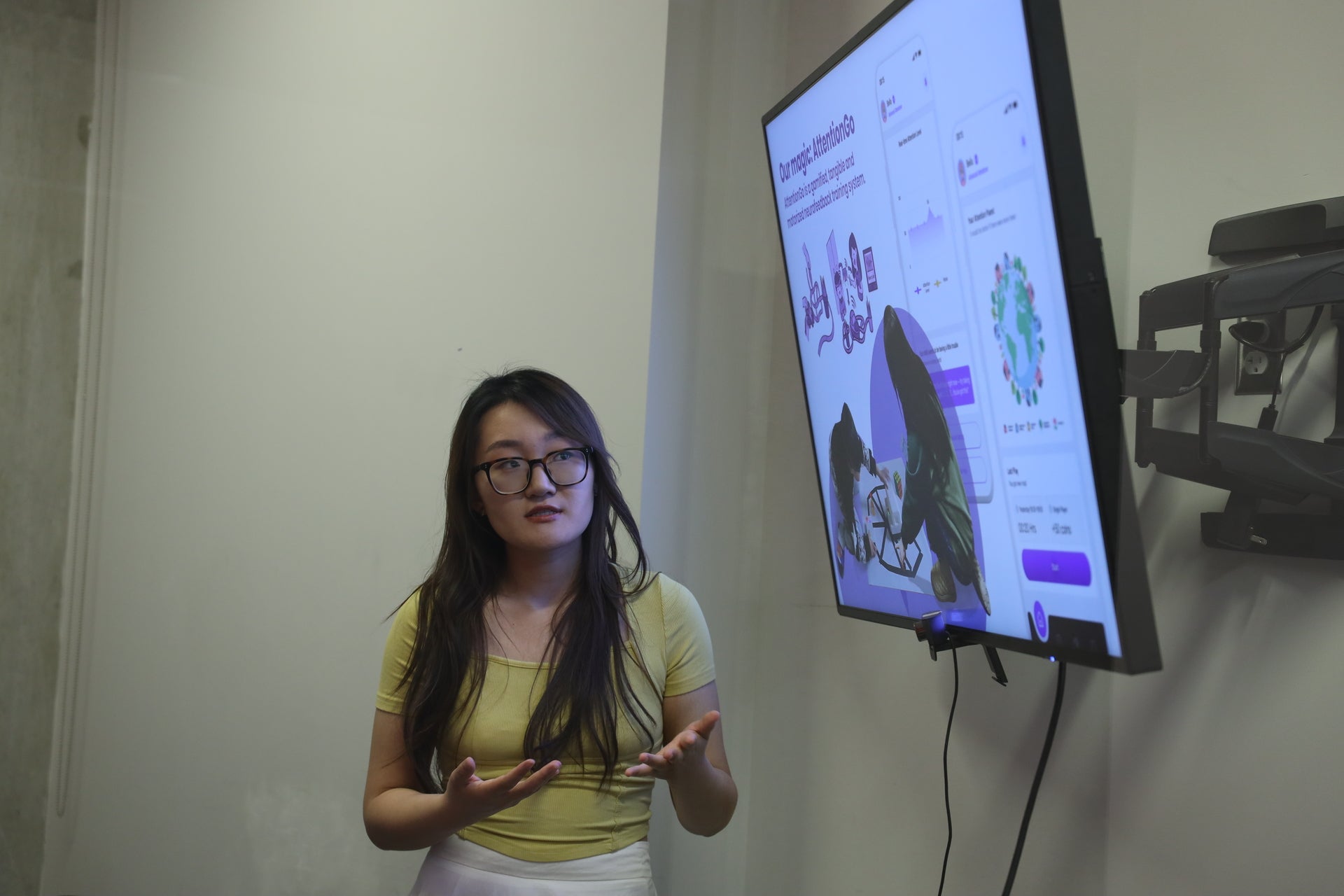
Bella presenting AttentionGo at ARC's Pitch Day, delivering her first-ever business pitch.
Leading up to Pitch Day, there were many things Bella had to unlearn as an academic.
“Research is usually evidence-based. We only claim what we can prove,” Bella says. “But a lot of business models are built on assumptions, something you cannot fully validate. Learning to present ideas based on assumptions was challenging.”
“I’m an introvert, so I feel shy sharing my work. But ARC taught me that you must have more confidence in your product than other people in the room. Because that’s the only way others will believe in it.”
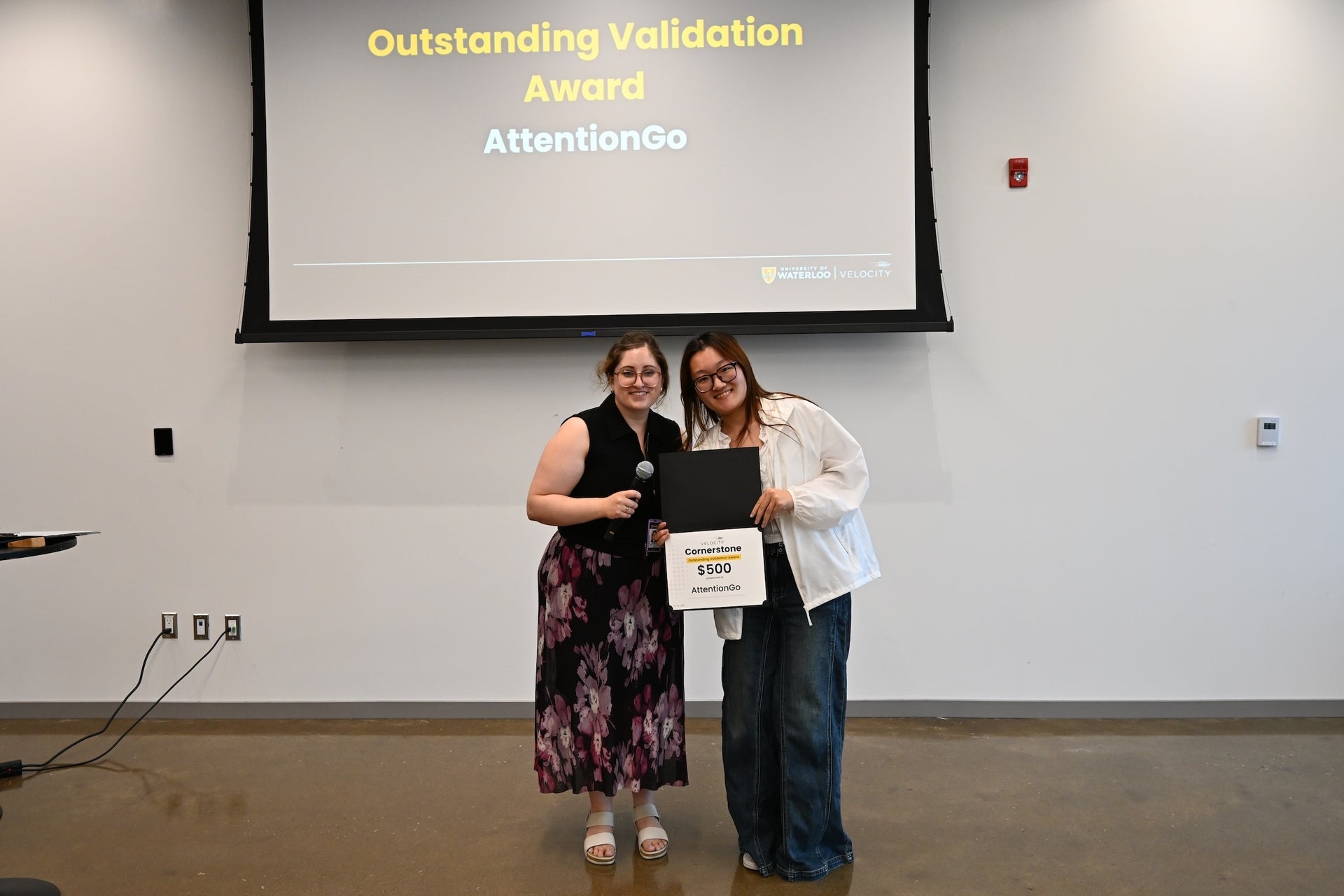
These challenges paid off, as Bella was among 11 recipients to win ARC. She was also part of Velocity’s two-week sprint program, Cornerstone. There, she received Velocity’s Outstanding Validation Award for her efforts in consulting potential users and using their insights for launching her startup. These were major milestones as it was Bella’s first-ever business pitch and her first time presenting her work to the public.
Bella created AttentionGo, a home-based program that helps children with attention-deficit/hyperactivity disorder (ADHD) strengthen their attention skills. People with ADHD may struggle with focus, time management, and organization, which can impair their academics, professional performance, and personal relationships. Although people with ADHD can take medication to improve their focus, it may lead to side effects like stomach issues or sleep difficulties.
Instead, AttentionGo leverages neurofeedback training (NFT), a computer-based program that gives real-time feedback in the form of sounds or games to help people regulate their own brain activity. For example, someone with anxiety may use NFT to train themselves to exhibit calmer and more relaxed brainwaves. The method has been explored by other Cheriton School of Computer Science students, notably PhD student Yue Lyu, who explored NFT through augmented reality-based games to help children with autism learn social cues and communication skills. Despite its immense potential, NFT is only available in clinics, placing financial and time barriers.
Bella is bringing NFT to neurodivergent families’ homes. During AttentionGo, a child wears an electroencephalogram (EEG) headband, which measures their brainwaves, including calmness, alertness, and concentration. They must also navigate a car on a racetrack using a controller. The more the child pays attention, the faster the car will go. Parents can also adjust the game’s difficulty levels to challenge their children. Through the power of play, AttentionGo can help children with ADHD build their attention skills over time.
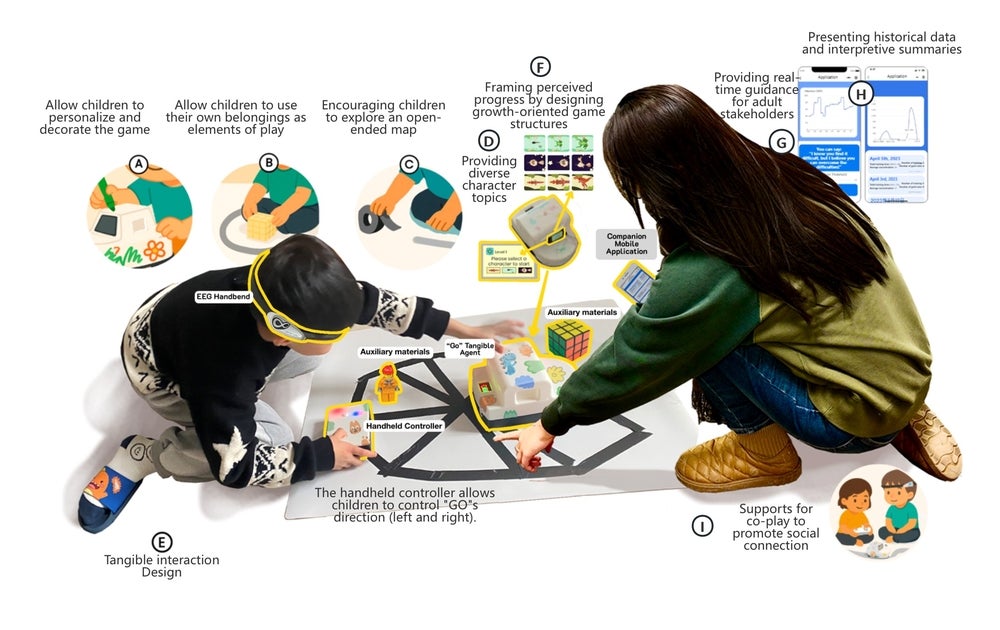
AttentionGo blends brain training technology with the power of play to support children with ADHD.
Notably, Bella based AttentionGo on self-determination theory, after discovering that past research has undermined neurodivergent children’s self-determination. For example, AttentionGo supports autonomy by allowing participants to design their car and map, and to co-develop the game’s rules.
She also included members of the ADHD community at the design’s core by consulting her brother, who has ADHD. The most recent iteration of AttentionGo was based on workshops with children with ADHD and their parents. Bella also used their feedback to create similar attention-training tools.
“I always say, I’m not the real designer of AttentionGo. My participants are the designers. I just help them build their vision into life,” says Bella.
With this funding, Bella will kickstart her startup by refining and patenting AttentionGo, which she believes has a long way to go.
“I am grateful to the judges for their feedback and investment,” says Bella. “But when I won, I felt the weight of what comes next. It isn’t just the start of a company for me. It’s the responsibility to help neurodivergent people like my younger brother find a better spot. There is still a lot of work I have to do before I can deliver this product into their hands.”
“Technology is powerful. But sometimes there is a gap between people’s needs and technology. I hope to bridge this gap to help people live their lives better.”