A Cheriton School of Computer Science-led research team won the Social Impact Award at the 2026 Canadian Undergraduate Conference on AI (CUCAI), held in early March.
CUCAI is Canada’s largest undergraduate AI conference. Every year, it connects around 300 students nationwide with industry leaders and innovators to “inspire the future leaders of AI.”
CUCAI selects five teams out of dozens of applicants to conduct a spotlight presentation on their research. Among those selected were PhD student Christopher Risi, and undergraduate students, Divyansh Bhandari, Tony Chan, Kirpa Chandok, Alyssa D'Souza, Cristiano Da Silva, Jonathan Gong, Arohi Gopal, Shivam Singal, Gavin Katz, Vilo Rao, Yimeng Xie, and Julia Zhu. They showcased their diabetes-management technology, which earned them the award.
The conference took place at the University of Toronto, where insulin and its treatment for diabetes were discovered in 1921. Sharing the same stage as its discoverers carried a special weight for Christopher, who was diagnosed with Type 1 diabetes in 2023.
“The event was held in the Medical Sciences Building. All over the walls were murals dedicated to Frederick Banting and Charles Best, the people who saved my life. Their legacy was everywhere,” Christopher says. “My students and I found photos of Banting’s graduation class. All of that made the award even more meaningful.”
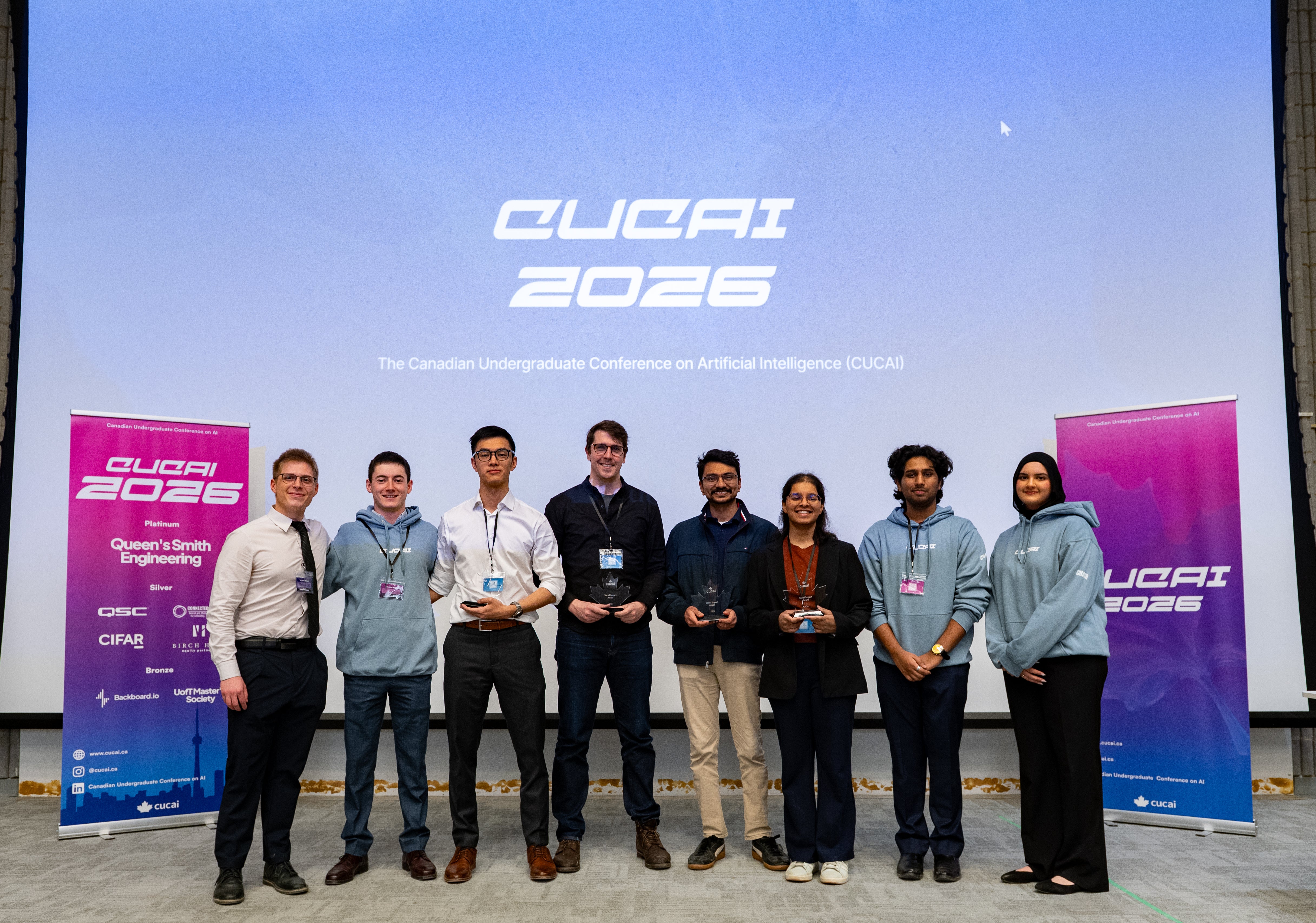
(Third from the left to right): Tony Chan, Christopher Risi, Shivam Singal and Alyssa D'Souza on stage with the Social Impact award. Kirpa Chandok also attended the conference but wasn't photographed.
A century after Drs. Banting and Best’s breakthrough, Christopher is hoping AI can further push diabetes care.
When we eat, the carbohydrates in our food are converted into glucose, our body’s main source of energy. Insulin is key to moving glucose from our blood into our cells, thus fueling our bodies. However, people with Type 1 diabetes don’t produce insulin, so they must administer it by injection or pump to maintain their body’s blood glucose levels, also known as blood sugar levels.
“Your blood is supposed to have about four to eight grams of sugar at all times,” explains Christopher. “That’s equal to a teaspoon or two. Your pancreas is incredible at keeping that number within that range. When your blood sugar level is too high, your body is just secreting tons of insulin. If it’s too low, your body stops production. But when you have Type 1 diabetes, those pancreatic islet cells are sort of dead or non-functioning.”
If a person’s blood sugar levels are too high, a condition called hyperglycemia, it can cause long-term complications, including blindness and increased risk of cardiovascular disease. Hypoglycemia occurs when the blood sugar levels are too low. It can be an immediate medical emergency, with symptoms including confusion, loss of consciousness or seizures.
One of the biggest nightmares for people with Type 1 diabetes is dead-in-bed (DIB) syndrome, where an otherwise healthy diabetic passes away in their sleep. It is believed that nighttime hypoglycemia can trigger cardiovascular-related problems, including heart arrhythmia and cardiac autonomic neuropathy, causing DIB syndrome.
“It’s thought to be the leading cause of death for Type 1 diabetics under 40,” explains Christopher.
He wants to help people with diabetes reduce the risk of DIB by leveraging time series foundation models, a type of AI model pre-trained on massive datasets to recognize patterns and forecast future values from historical data. Similar technology is used to predict stock prices, energy demand, and weather.
The team’s model can forecast blood sugar levels up to 8 hours ahead, specifically, nocturnal blood sugar levels. While most continuous glucose monitoring–based prediction systems typically forecast only 30 minutes. If a user knows their levels are likely to drop or rise overnight, they could intervene by modifying their food or insulin intake. This feature is essential since hitting the sweet spot between insulin and food portions is difficult, given the dozens of factors that can impact blood sugar levels. For example, alcohol consumption or exercise can greatly decrease these levels, while a sunburn can raise them.
Their models could also make diabetes management less stressful. Although devices like continuous glucose monitors can notify people with diabetes about concerning blood sugar levels, they can be inconvenient.
“There is so much anxiety around sleep for people using insulin,” says Christopher. “Sometimes, phones can die, or you’re too deep in sleep and don’t wake up. Besides, who wants to be woken up multiple times a night to eat candy?”
With such an ambitious project, Christopher realized he could scale his vision to incorporate more datasets and models, while creating real-world research opportunities for undergraduate students. He collaborated with WAT.ai, the undergraduate student body of the Waterloo Data and Artificial Intelligence Institute, to recruit student researchers. Together, they developed a variety of state-of-the-art models using datasets of hundreds of patients and over 50 million datapoints from continuous glucose monitors.
Leading a team of 12 students while being newly diagnosed with diabetes, starting a job with industry research partner, Gluroo, and teaching an undergraduate course for the first time was no small feat. But the effort paid off: the team produced a benchmarking study evaluating the ability of time series foundation models to forecast nocturnal hypoglycemia, as well as an open-source code repository for the broader research community. They also plan to publish a paper on their findings.
He also felt proud that he played a role in Waterloo’s innovative spirit.
“What I love about Waterloo is that students here don't just want to learn; they want to build something that matters. So many students were drawn to this project, not just for the research, but because they genuinely wanted to help people. My team showed up every week ready to push this forward. That dedication made this possible.”