When Genius Failed

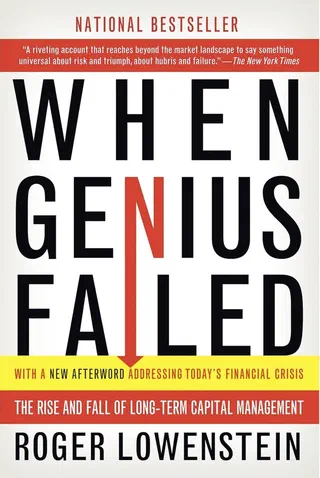
Table of Contents
By Roger Lowenstein (Random House, 2000).
THE RISE OF LONG-TERM CAPITAL MANAGEMENT
Chapter 1: Meriwether
-
Bonds have a particular appeal to mathematical types because so much of what determines their value is readily quantifiable.
-
But if he (Meriwether) had the capital to stay the course, he’d be rewarded in the long run, or so his experience seemed to prove.
-
while a losing trade may well turn around eventually (assuming, of course, that it was properly conceived to begin with), the turn could arrive too late to do the trader any good–meaning, of course, that he might go broke in the interim.
-
He was so intensely private that even when the Long-Term Capital affair was front-page news, a New York Times writer, after trying to determine if Meriwether had any siblings, settled for citing the inaccurate opinion of friends who thought him an only child.
-
It was just this element of passion that Meriwether wanted to eliminate; he preferred the cool discipline of scholars, with their rigorous and highly quantitative approach to markets.
-
Meriwether, a math teacher with an M.B.A. from Chicago
-
If a trade went against them, the arbitrageurs, especially the ever-confident Hilibrand, merely redoubled the bet.
-
Meriwether had the particular genius to bring this group to Wall Street-a move that Salomon’s competitors would later imitate. “He took a hunch of guys who in the corporate world were considered freaks,” noted Jay Higgins, then an investment hanker at Salomon. “Those guys would be playing with their slide rules at Bell Labs if it wasn’t for John, and they knew it.”
-
He nurtured his traders, all the while building a protective fence around the group as sturdy as the red board fence in Rosemoor.
-
Another defector was treated like a traitor; Meriwether vengefully ordered the crew not to even golf with him.
-
One time, a trader named Andy who was losing money on a mortgage trade asked for permission to double up, and J.M. gave it rather offhandedly. “Don’t you want to know more about this trade?” Andy asked. Meriwether’s trusting reply deeply affected the trader. J.M. said, “My trade was when I hired you.”
-
Meriwether had married Mimi Murray, a serious equestrian from California, in 1981, and the two of them lived in a modest two-bedroom apartment on York Avenue on the Upper East Side. They wanted children, according to a colleague, but remained childless.
-
Meriwether disdained attention (he purged his picture from Salomon’s annual report) and refused to dine on any food that smacked of French.
-
Gutfreund fended Perelman off by selling control of the firm to a distinctly friendly investor, the billionaire Warren Buffett.
-
Typically, J.M. left himself out of the arrangement, telling Gutfreund to pay him whatever he thought was fair. Then Arbitrage had a banner year, and Hilibrand, who got the biggest share, took home a phenomenal $23 million. Although Hilibrand modestly continued to ride the train to work and drive a Lexus
-
Although upset with Mozer, Meriwethcr stayed loyal to him. It is hard to imagine the clannish, faithful J.M. doing otherwise. He defended Mozer as a hard worker who had slipped but once and left him in charge of the government desk.
-
No matter; one simply did not–could not–deceive the US Treasury. Gutfreund, a lion of Wall Street, was forced to quit. Buffett flew in from Omaha and became the new, though interim, CEO.
-
This painful dollop of limelight made him even more secretive, to Long-Term Capital’s later regret.
-
he made a near-catastrophic bet in mortgages and fell behind by $400 million. Most traders in that situation would have called it a day, bur Hilihrand was just warming up; he coolly proposed that Salomon double its commitment! Because Hilibrand believed in his trade so devoutly, he could take pain as no other trader could.
-
It was said that only once had he ever suffered a permanent loss, a testament to the fact that he was not a gambler.
-
it reminded Salomon’s managers that while Hilibrand was critiquing various departments as being so much extra baggage, Arbitrage felt free to call on Salomon’s capital whenever it was down.
-
Without admitting or denying guilt, Meriwethcr settled the case, agreeing to a three-month suspension from the securities industry and a $50,000 fine.
-
The Mozer scandal had ended any hope that J.M. would take his place at the top of Salomon
Chapter 2: Hedge Fund
-
Benjamin Graham, known as the father of value investing, ran what was perhaps the first (hedge fund).
-
No one had thought to apply the term to an investment fund until Alfred Winslow Jones, the true predecessor of Meriwether, organized a partnership in 1949. Though such partnerships had long been in existence, Jones, an Australian-born Fortune writer, was the first to run a balanced, or hedged, portfolio.
-
a conservative approach, likely to make less but also to lose less
-
Merton was the son of a prominent Columbia University social scientist, Robert K. Merton, who had studied the behavior of scientists. Shortly after his son was horn, Merton pere coined the idea of the “self-fulfilling prophecy”
-
when he played poker, he would stare at a lightbulh to contract his pupils and throw off opponents.
-
Merton, working under the wing of the famed Paul Samuelson, did nothing less than invent a new field.
-
He (Merton) called this “continuous time finance.”
-
Merton completed the puzzle with an elegantly mathematical flourish. Then he graciously waited to publish until after his peers did; thus, the formula would now be known as the Black-Scholes model.
-
in the summer of 1993, J.M. recruited a second academic star: Myron Scholes.
-
Scholes had also worked at Salomon, so he, too, was close to the Meriwether group.
-
Long-Term set a minimum of $10 million per investor.
-
Each partner–J.M. dubbed them “strategic investors “–would invest $100 million and share inside dope about its local marker.
-
despite Merrill’s pleading, the partners remained far too tight-lipped about their strategies. Long-Term even refused to give examples of trades
-
Suddenly, Andrew Chow, a cheeky thirty-year-old derivatives trader, blurted out, “There aren’t that many opportunities; there is no way you can make that kind of money in Treasury markets.” Chow, whose academic credentials consisted of merely a master’s in finance, seemed not at all awed by the famed Black-Scholes inventor. Furious, Scholes angled forward in his leather-backed chair and said, “You’re the reason–because of fools like you we can.” The Conseco people got huffy, and the meeting ended badly. Merrill demanded that Scholes apologize. Hawkins thought it was hilarious; he was holding his stomach laughing.
-
The son of an Ontario dentist, Scholes was an unlikely scholar…After college, in 1962, the restless Scholes got a summer job as a computer programmer at the Universitv of Chicago, despite knowing next to nothing about computers…Scholes’s computer work was so invaluable that the professors urged him to stick around and take up the study of markets himself.
-
Despite his credo, Scholes was never fully convinced that he couldn’t beat the market. In the late 1960s, he put his salary into stocks and borrowed to pay his living expenses. When the market plummeted, he had to beg his banker for an extension to avoid being forced to sell at a heavy loss. Eventually, his stock recovered–not the last time a Long-Term partner would learn the value of a friendly banker.
-
And Scholes was a foremost expert on tax codes;, both in the United States and overseas. He regarded taxes as a vast intellectual game: “No one actually pays taxes,” he once snapped disdainfully. Scholes could not believe there were people who would not go to extremes to avoid paying taxes
-
Not coincidentally, Leahy and McEntee were fellow Irish Americans, a group with whom J.M. always felt at home.
-
Mullins, too, was a former student of Merton’s at MIT who had gone on to teach at Harvard, where he and Rosenfeld had been friends.
-
In the United States, Long-Term got money from a diverse group of hotshot celebrities and institutions. Michael Ovitz, the Hollywood agent, invested; so did Phil K night, chief executive of Nike, the sneaker giant, as well as partners at the elite consulting firm, McKinsey & Company and New York oil executive Robert Belfer. Cayne, the chief executive of Bear Stearns, figured that Long-Term would make so much money that its fees wouldn’t matter. Like others, Cayne was comforted by the willingness of J.M. and his partners to invest $146 million of their own. (Rosenfeld and others put their kids’ money in, too.)
-
Long-Term opened for business at the end of February 1994…In addition to its eleven partners, the fund had about thirty traders and clerks and 10 million worth of SPARC workstations…Long-Term’s fund-raising blitz had netted 1.25 billion–well short of J.M.’s goal but still the largest start-up ever.
Chapter 3: On the Run
-
The Swashbuckling Steinhardt lost 800 million of his investors’ money in a mere four days. George Soros, who was jolted by a ricochet effect on international currencies, dropped 650 million for his clients in two days.
-
the securities might be unrelated, but the same investors owned them, implicitly linking them in times of stress… The very concept of safety through diversification–the basis of Long-Term’s own security–would merit rethinking.
-
The mistake is in thinking that markets have a duty to stay liquid or that buyers will always be present to accommodate sellers. The real culprit in 1994 was leverage. If you aren’t in debt, you can’t go broke and can’t be made to sell, in which case “liquidity” is irrelevant.
-
But some institutions were so timid, so bureaucratic, that they refused to own anything hut the most liquid paper. Long-Term believed that many opportunities arose from market distortions created by the sometimes arbitrary demands of institutions.
-
But what if, using leverage, that tiny spread could be multiplied? What if, indeed! With such a strategy in mind, Long-Term bought $1 billion of the cheaper, off-the-run bonds. It also sold $1 billion of the more expensive, on-the-run Treasurys. This was a staggering sum. Right off the hat, the partners were risking all of Long-Term’s capital! To be sure, they weren’t likely to lose very much of it.
-
Long-Term, with trademark precision, calculated that owning one bond and shorting another was one twenty-fifth as risky as owning either bond outright. Thus, it reckoned that it could prudently leverage this long/short arbitrage twenty-five times.
-
Long-Term pulled off the entire $2 billion trade without using a dime of its own cash.
-
normally, when you borrow a bond from, say, Merrill Lynch, you have to post a little bit of extra collateral-maybe a total of $1010 on a $1000 Treasury and more on a riskier bond. That $10 initial margin, equivalent to 1 percent of the bond’s value, is called a haircut. It’s Merrill Lynch’s way of protecting itself in case the price of the bond rises.
-
from the very start, it was Long-Term’s policy to refuse to pay the haircut or else to substantially reduce it.
-
The partners could say to each new bank, " If we give you a haircut, we have to give it to everyone.” So they ended up giving it to nobody.
-
Lesser partners such as Myron Scholes were forever angling for more money, as well as more authority.
-
on a private drive that the Meriwethers shared with their only neighbor, the entertainer David Letterman.
-
With mortgage rates dropping below 7 percent for the first rime since the Vietnam War
-
Giovannini, who had also studied at MIT…Still not satisfied, Haghani brought in Gerard Gennotte, yet another MIT grad
-
The partners assumed that, all else being equal, the future would look like the past.
-
The common notion that Long-Term had a unique black box was a myth. Other Wall Street firms had also found their way to MIT and most of the big banks were employing similar models–and, what’s more, were applying them to the same couple of dozen spreads in bond markets. Long-Term’s edge wasn’t in its models but, first, in its experience in reading the models. The partners had been doing such trades for years. Second, the firm had better financing.
-
investors were turning “a blind eye to the consequences of ‘outlier’ events,” “Successful investors have positioned themselves to avoid the 100-year flood”
Chapter 4: Dear Investors
-
In a strict sense, there wasn’t any risk–if the world had behaved as it did in the past.–Merton Miller
-
what if you could make that bet on 1 million rolls and settle up only at the end?
-
While it heartily acknowledged risk, it banished uncertainty by putting numerical odds on its likelihood of loss.
-
Neither Merton nor Scholes was involved in trading at Long-Term except in a minor, advisory sense. Nor, as some investors believed, did the professors create the “models” that detailed the cases for various trades.
-
Long-Term was an experiment in managing risk by the numbers. At the center of this experiment was the notion of volatility, which had supplanted leverage, in the partners’ minds, as the best proxy for risk.
-
But Black-Scholes makes a very key assumption: that the volatility of a security is constant.
-
Merton’s theories were seductive not because they were mostly wrong but because they were so nearly, or so nearly often, right.
-
As the unassuming Rosenfeld described it, he and his fellow Merton proteges used to run to the physics library looking for formulaic solutions that they could “jam into finance.”
-
Paul Samuelson, Merton’s mentor at MIT, had doubts when Long-Term was organized.
-
Eugene Fama, Scholes’s thesis advisor, wondered what his old student was up to as well.
-
markets have memories
-
Curiously. Fama devoted the rest of his career to justifying the efficient-market hypothesis. He argued that Black Monday had heen a rational adjustment to a (one-day?) change in underlying corporate values. On the other hand, Robert Shiller, a professor at Yale University, told The Wall Street Journal after the crash, “The efficient market hypothesis is the most remarkable error in the history of economic theory.”
-
History, Mark Twain noted, rhymes; it does not repeat.
-
J.P. Morgan, which pioneered the methodology (value-at-risk, under the brand name RiskMetrics), candidly admitted its flaws.
-
volatilities “are themselves quite volatile.”
-
(Morgan) continued to use Value-at-Risk. Morgan couldn’t find any “persuasive alternatives,” the bank explained–as if that would make up for its shortcomings.
-
To William F. Sharpe, a Nobel prize-winning economist and an adviser to one of Long-Term’s investors, the returns seemed surreally smooth. “We distinctly asked, ‘What’s the risk?’” Sharpe recalled. “Myron [Scholes] said, ‘Well, our goal is to get the risk level [the volatility] of the S&P 500.’ He said, ‘We’re having trouble getting it that big.’”
-
at the end of 1995, it was leveraged 28 to 1. Of course, its return on total assets–both those that it owned and those that it had borrowed–was far, far less than the gaudy return cited above. This return on total capital was approximatelv 2.45 percent.
-
The point is that almost all of its heady 59 percent return was due to the remarkable power of leverage.
-
Its derivative trades, in particular, required no capital up front. The fund simply settled with its hanks each day, paying or receiving cash depending on which way a trade had moved. In lieu of working capital, Long-Term designated a hypothetical slice of its equity as standing behind each trade.
-
it is fair to ask, Was the insurer that good, or was it merely lucky ?
Chapter 5: Tug-of-War
-
By the Spring of 1996, Long-Term had an astounding $140 billion in assets, thirty times its underlying capital.
-
Long-Term disclosed its total assets and liabilities to its banks on a quarterly basis and to investors every month.
-
“People got statements. It was a failure to connect the dots.”
-
Typically, J.M. asked a lot of questions and let his guests do the talking, and Allison noticed that he remembered the answers–even little things, such as the name of Allison’s wife–just as he remembered trades. J.M. was always a good listener.
-
At the time, Long-Term was thinking of forming a splinter fund–LCTM-X, it was dubbed–to invest in especially high risk trades and also to focus on Latin America.
-
Their total profits in 1996 were an astounding $2.1 billion. To put this num ber i nto perspective, this small band of traders, analysts, and researchers, unknown to the general public and employed in the most arcane and esoteric of businesses, earned more that year than McDonald’s did selling hamburgers all over the world, more than Merrill Lynch, Disney, Xerox, American Express, Sears, Nike, Lucent, or Gillette–among the best-run companies and best-known brands in American business.
Chapter 6: A Nobel Prize
-
J.M.’s personal loyalties weighed on portfolio considerations, a serious flaw in a risk manager.
-
Warren Buffett, who, through Berkshire Hathaway, was Salomon’s biggest shareholder, was constitutionally opposed to investing more money in failing enterprises, which time and again he had equated with throwing good money after had.
-
“It’s a wrong perception to believe that you can eliminate risk just because you can measure it.” (Merton)
-
Speculators then turned their guns on the Hong Kong dollar. The government, still under the British Crown, retaliated, raising overnight interest rates to a staggering 300 percent. The island’s stock market gave up 23 percent in a week.
-
Ironically, by merging with its flamboyant rival, Swiss Bank had become a party to the Long-Term warrant that it previously had spurned.
-
Scholes decided not to invest his half of the million-dollar Nobel bounty in the fund.
-
Merton had dyed his hair red, left his wiie, and moved into a snazzy pad in Boston.
-
In times of trouble, markets become more closely linked, and seemingly unrelated assets rise and fall in tandem.
THE FALL OF LONG-TERM CAPITAL MANAGEMENT
Chapter 7: Bank of Volatility
-
Markets can remain irrational longer than you can remain solvent. –John Maynard Keynes
-
According to one estimate, Hilibrand alone was worth half a billion dollars and Meriwether was in the low hundreds of millions.
-
when a stock is added to the index, many portfolios are compelled to buy it
-
Scholes protested about the size of the firm’s various positions. Merton, Mullins, and McEntee made protests, too. But the dissenters stopped short of threatening to quit, the one step that might have prompted J.M. and Rosenfeld to confront their two top traders (Hilibrand and Haghani).
-
Totally dominated by the two senior traders, Long-Term had become a lopsided firm; it was a partership only in name.
-
To suffer the organization telling you that you are losing business–it takes a tremendous amount [of courage] to stand up and say, ‘I’m not going to do it.’
-
trader’s at Salomon (now Salomon Smith Barney) took home a percentage of their profits. Since the traders were not penalized for losses, they had a perverse incentive to bet as much of the company’s money as they could.
-
The Long-Term partners badly underestimated the seriousness of the second biggest player in their business calling it quits.
-
the Communist-dominated Duma, the lower house of Parliament, rejected reform measures urged on it by the IMF. Then the members went on vacation. When the government begged the Duma to reconvene, the members refused–but by then many government leaders, including President Boris Yeltsin, were also at seaside dachas, leaving the country to sort out its misery.
-
the fund went “outright long in Russia–right at the end.” Said another, miserably, “It was so against our way.”
Chapter 8: The Fall
-
The question … is whether the LTCM disaster was merely a unique and isolated event, a bad drawing from nature’s urn; or whether such disasters are the inevitable consequence of the Black-Scholes formula itself and the illusion it may give that all market participants can hedge away all their risk at the the same time. –Merton H. Miller
-
Their fund had $3.6 billion in capital, of which two fifths was personally theirs. It would take only five weeks for them to lose it all.
-
Enigmatic to the end, Russia said its moratorium would apply to $13.5 billion of local (ruble) debt–breaking the rule, honored even in the depths of the Latin American debt crisis, that a government honors its own coin.
-
Long-Term, which had calculated with such mathematical certainty that it was unlikely to lose more than $35 million on any single day, had just dropped $553 million– 15 percent of its capital–on that one Friday in August. It had started the year with $4.67 billion. Suddenly, it was down to $2.9 billion. Since the end of April, it had lost more than a third of its equity.
-
Soros, a wily refugee from Communist Hungary
-
“The idea that you have a bell-shape curve is false. You have outlying phenomena that you can’t anticipate on the basis of previous expnience.” (Soros)
-
When losses mount, leveraged investors such as Long-Term are forced to sell, lest their losses overwhelm them.
-
He (Meriwether) signed over his only real estate property–a twenty-acre lot in tony Pebble Beach, California–to his wife (his Westchester estate was already in Mimi’s name).
-
“When you’re down by half, people figure you can go down all the way. They’re going to push the market against you. They’re not going to roll [refinance] your trades. You’re finished.” (Mattone to Meriwether)
-
When you need money, Wall Street is a heartless place.
-
Three quarters of all hedge funds lost money in August, and Long-Term did the worst of any of them. In one dreadful month, Meriwether’s gang lost $1.9 billion, or 45 percent of its capital, leaving it with only $2.28 billion.
Chapter 9: The Human Factor
-
Long-Term faxed the confidencial letter on September 2, but one of the investors leaked it to Bloomberg, the financial news service, which published it even before the last investor had gotten his copy.
-
As it scavenged for capital, Long-Term had been forced to reveal bits and pieces and even the general outline of its portfolio. Ironically, the secrecy-obsessed hedge fund had become an open hook. Markets, as Vinny Marrone might say, conspire against the weak. And thanks to Meriwether’s letter, all Wall Street knew about Long-Term’s troubles. Rival firms began to sell in advance of what they feared would be an avalanche of liquidating by Long-Term. “As people smelled trouble, they started getting out,” Costas Kaplanis, then a trader at Salomon, remarked. “Not to attack LTCM–to save themselves.” As they hammered away at Long-Term’s trades, Leahy felt sick, as though the firm’s competitors were liquidating Long-Term’s own position for it. Hilibrand had not been wrong: when you bare your secrets, you’re left naked.
-
investors will knock down the door of a high-priced manager and then abandon him when he cuts his rate.
-
When Scholes, his former colleague at Stanford, called to raise more money, Sharpe was wary. His client, a wealthy Chinese American, was ready to invest $30 million; the professor said it was too risky.
-
According to witnesses, the headstrong Goldfield appeared to be downloading Long-Term’s positions, which the fund had so zealously guarded, from Long-Term’s own computers directly into an oversized laptop (a detail that Goldman later denied). Meanwhile, Goldman’s traders in New York sold some of the very same positions.
-
Brazenly playing both sides of the street, Goldman represented investment banking at its mercenary ugliest. To J.M. and his partners, Goldman was raping Long-Term in front of their very eyes.
-
Meriwether bitterly complained to the Fed’s Peter Fisher tha Goldman, among others, was “front-running,” meaning trading against iton the basis of inside knowledge. GOldman, indeed, was an extremely active trader in mid-September, and rumors that Goldman was selling Long-Term’s positions in swaps and junk bonds were all over Wall Street. In fact, its high-yield traders were said to be bragging about it.
-
The partners’ bunkered view of the world made them highly susceptible to conspiracy theories, particularly since such explanations shifted the blame for their losses to others.
-
Investment banks that also operate proprietary bond-trading desks, such as Salomon and Goldman, publicly boasted of exploiting their knowledge of the “customer flow.”
-
Scholes made a long-scheduled visit to his hometown, Hamilton, Ontario
-
Yet amid this unceasing agony, the partners mostly kept their feelings in check. Their simmering resentments never, or very rarely, bubbled into the open. They continued working together and refrained from shouting or openly pointing fingers.
Chapter 10: At The Fed
-
The side of the Fed most often seen in public is its governing board, in Washington, which has the high-profile job of adjusting short-term interest rates.
-
Fisher ran the Fed’s trading desk and oversaw a $450 billion portfolio of government securities. When Greenspan wanted to tighten or loosen monetary conditions, Fisher and his staff actually carried out the directive by either buying more securities or selling some.
-
Long-Term’s trades were linked–they had been correlated before the fact. “They had the same spread trade everywhere in the world,” Fisher thought. Gensler had a related thought: During a crisis, the correlations always go to one.
-
Steve Black, the Salomon Smith Barney executive, heard from his troops in Tokyo that Goldman was “banging the s– " out of Long-Term’s trades, especially swaps. Goldman said Salomon was doing the same in Europe.
-
The obvious manipulation cost the fund $120 million.
-
Long-Term’s total loss on Monday was 553 million, coincidentally equal to its loss of a month before. In percentage terms, this Monday’s loss was far worse: it ate through a third of Long-Term’s equity, leaving it with just under a billion dollars. And the fund still had more than 100 billion in assets. Thus, even omitting derivatives, its leverage was greater than 100 to 1–a fantastic figure in the annals of investment.
-
Twelve banks had sent twenty-five bankers-all men, all middle-aged.
-
“When you get to a high level. how much do you really understand about the details under you?”
-
Lehman objected that it shouldn’t be asked for the same contribution as the bigger banks-why shouldn’t each hank invest according to its exposure?
-
at least two banks were in on every phone call, to avoid the possibility of secret dealing.
-
Buffert was proposing to pay 210 million for a fund that had been worth 4.7 billion at the start of the year. By day’s end, Long-Term, which was suffering yet another down day in markets, would be worth only $555 million.
-
just to make sure that Meriwether would not shop his offer around, Buffett issued a deadline of 12:30 P.M., not quite an hour away.
-
J.M. was furious at Goldman and AIG for trading against the fund–indeed, for helping to knock it down before trying to buy it on the cheap.
-
But Mead (Goldman’s counsel) did not have authority to change the bid, and Buffet was bizarrely unreachable.
-
Details of the meeting leaked.
-
their investment in Long-Term–once worth $1.9 billion–was totally gone, most of it lost in a mere five weeks.
-
The “strategic relationship” that Mathis Cabiallavetta had hoped would revitalize UBS had ended up costing the bank $700 million.
-
a creditor is also beholden to his debtor.
-
He (Hilibrand) didn’t want to sign, he wailed; there was nothing in it for him, better to file for bankruptcy than be someone else’s indentured servant with no hope of ever earning his way out. Meriwether took Hilibrand aside and talked to him about the group, and how the others were in it and needed him to be in it, and still, Hilibrand, who had never needed anyone and who had once rebelled at paying for his share of the company cafeteria but now couldn’t pay his debts, refused. Then Allison talked to him and said they were trying to restore the public’s faith in the system and not to destroy anybody, and Meriwether said, “Larry, you better listen to Herb.” And Hilibrand signed, and the fund was taken over by fourteen banks.
Epilogue
-
Motivated by insatiable greed, they had forcibly cashed out their outside investors only months before, leaving themselves to withstand, virtually alone, the brunt of the collapse. The wizards of Wall Street personally lost 1.9 billion. Larry Hilibrand, the most cocksure of traders, who had previously been worth close to half a billion dollars, awoke to discover that he was broke. Forced to live off the assets of his wife, Deborah, he had to plead with Credit Lyonnais to spare him the ignominy of personal bankruptcy while he tried to work off a crushing $24 million debt.
-
most of the partners remained far richer than ordinary Americans
-
Though tacitly conceding that the models had failed, he (Merton) insisted that the solution was to design ever-more elaborate and sophisticated models.
-
Goldman let it be known that–at the right price–Warren Buffett would still be an eager suitor for Long-Term.
-
thanks to the rescue, Long-Term met every margin call. All of its debts to creditors were repaid in full.
-
illiquidity was merely the expression of the problem, not its cause.
-
Permitting such losses to occur is what deters most other people and institutions from taking imprudent risks. Now especially, after a decade of prosperity and buoyant financial markets, a reminder that foolishness carries a price would be no bad thing.
-
The government’s emphasis should always be on prevention, not on active intervention.
-
diversification–one of the shibboleths of modern investing, but an overrated one. As Keynes noted, one bet soundly considered is preferable to many poorly understood. The Long-Term episode proved that eggs in separate baskets can break simultaneously.
-
It got so big that it distorted the very markets on whose efficiency the firm relied.
-
The professors overlooked the fact that people, traders included, are not always reasonable. This is the true lesson of Long-Term’s demise. No matter what the models say, traders are not machines guided by silicon chips; they are impressionable and imitative; they run in flocks and retreat in hordes.
-
The belief that tomorrow’s risks can be inferred from yesterday’s prices and volatilities prevails at virtually every investment bank and trading desk.
-
The next time a Merton proposes an elegant model to manage risks and foretell odds, the next time a computer with a perfect memory of the past is said to quantify risks in the future, investors should run–and quickly–the other way.
-
In November 1999, JWM Partners–the principals were Meriwether, Haghani, Hilibrand, Leahy, Rosenfeld, and Arjun Krishnamachar–circulated an offering document for “Relative Value Opportunity Fund II.” … In December, fifteen months after he lost $4.5 billion in an epic bust that seemed about to take down all of Wall Street and more with him, Meriwether raised \$250 million, much of it from former investors in the ill-fated Long-Term Capital, and he was off and running again.
Afterword, 2010
-
Ten years to the month after the rescure of Long-Term Capital Management, the following events ocurred: the mortgage giants Fannie Mae and Freddie Mac were bailed out by the U.S. government; Lehman Brothers failed; AIG was rescued by the Federal Reserve; the Federal Deposit Insurance Corporation saved Goldman Sachs and Morgan Stanley from imminent peril by converting them to commercial banks; the U.S. Treasury bailed out the money market industry; and legislation was introduced (and, shortly thereafter, approved) to advance federal investiment in the country’s banks… One firm conspicuously missing from the group–the only one that had refused to help rescue LTCM–was Bear Stearns. In March 2008, itself on the verge of failure, Bear had been swallowed whole by an acquirer assisted by the Fed. Bear, it was said, had not learned its lesson from LTCM.
-
in the ensuing decade, the modelers at Fitch, one of the firms that stamped the now-notorious mortgage securities as triple-A, did not envision even a modest 2 or 3 percent decline in housing prices. In the event, they were to fall 30 percent decline and more.
-
Meriwether himself had to reabsorb such lessons. In 2009, ten years after founding JWM Partners, a successor to LTCM, he suffered horrendous losses again. This second fund was also shuttered.
-
When banks could offload debts onto markets, there was a subtle shift in how credit was allocated.
-
it is the difference between recognizing the need for market supervision and adopting a pose of absolute noninterference.
-
the chimera of efficient or perfect markets should ever be laid to rest.
-
markets, we must emphasize, are imperfect; they are the agglomeration of myriad investors, most of whom usually act rationally–usually, as history has shown, but not always.
-
Solvency is especially precarious when institutions with a long-term need for capital are subject to the market’s short-term gyrations.
-
markets are rarely receptive to pleas for mercy.
-
restrict more tightly the types of casino-type markets; institutions in whose solvency society has an ongoing interest cannot be permitted to rely too heavily on leverage of any type, and on “hot money.”
To Read
-
Roger Lowenstein (1995). Buffett: The Making of an American Capitalist. Random House.
-
Roger Lowenstein (2004). Origins of the Crash: The Great Bubble and Its Undoing. Penguin.
- Roger Lowenstein (2010). The End of Wall Street. Penguin.
