My Journeys in Economic Theory

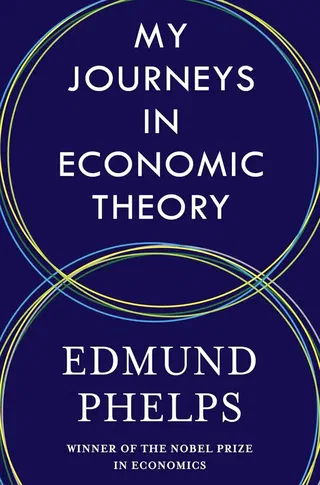
Table of Contents
By Edmund Phelps (Columbia University Press, 2023).
I did not know anything about Edmund Phelps’ work and I do not remember why on earth do I have a copy of his memoir. The cover says he received the Nobel prize in Economics in 2006, which was enough to keep me reading. While I was going through the book, I learned from the news that Phelps passed away on May 15, 2026.
The book is mostly a summary of Phelps’ work through different stages of his life. There are some personal stories in between (love and hate with his supervisor Jim Tobin, friendship with Paul Samuelson, Amartya Sen and John Rawls), which I enjoyed reading the most. It is fascinating that economists build (simple) models to explain/justify how economics (should) work. In some way this is similar to physicists, who aspire to build a model for the universe! However, there does appear to be one crucial difference: basic physical laws can be tested by anyone, but economics?
PREFACE
-
At the core of my intellectual development has been the excitement of hitting upon a new idea, of exercising my creativity rather than testing or applying others’ models.
-
I had been conceiving new elements with which to support or enrich the basic theories of others rather than conceiving a basic theory of my own.
-
at Yale’s Cowles Foundation for Research in Economics and in my time at the RAND Corporation and Massachusetts Institute of Technology … the Wharton School of the University of Pennsylvania and some time at the London School of Economics and in Cambridge … at Stanford University’s Center for Advanced Studies in the Behavioral Sciences (CASBS), then in New York, and soon after at Columbia University, my final home.
-
John Rawls, who I worked next door to at CASBS, had the greatest influence on my work in those years.
-
The notion of economic justice in addition to notions of racial and gender equality were new forces in social thought and policy discussion.
-
Most people need to work to live, but most people also need to express their creativity and talent.
-
In conceiving this theory of mass flourishing, I had the enormous satisfaction of making considerable use of my own creativity. In coming to understand the rather widespread phenomenon of meaningful lives, my own life became more meaningful.
INTRODUCTION: Formative Years
-
I was born in July 1933. My mother, father, and I lived in northern Chicago, a few blocks from Lake Michigan on Glenwood Avenue. I was to be an only child, like many kids in those times.
-
Both my parents had a college education. My mother studied home economics at James Millikin College (now University) in Decatur, and my father studied some economics and played on the baseball team at the University of Illinois at Champaign-Urbana.
-
my experience of the Great Depression. It is true that both my parents lost their jobs, but I was too young in those years to sense the loss my parents must have felt or to see any hardship they may have suffered. My grandfather, doing well enough in the shoe business, may have helped us out; and my mother’s brothers and sisters could also have helped.
-
In the summer of 1939, after placing advertisements in the papers, my father got a job in advertising and sales in New York City.
-
I often joined her when she went in the car to the train station to meet my father coming back from work.
-
I think their trusting and easy-going parenting helped me find my way to a richly rewarding life.
-
It could very well be that people who have talent in theorizing and testing in science also have some talent at expression in the arts.
-
In late summer 1951, it was time to leave home and go to college. I entered Amherst College, a men’s college beautifully situated in the Pioneer Valley of western Massachusetts.
-
I took required courses in a foreign language, calculus, and the sciences and completed physical tests, such as pull-ups and swimming. Each morning we had to be in the nondenominational Johnson Chapel for a sermon.
-
their boldness and their originality. We need to have these examples to stir us if we are to strike out in a new direction. Exposure to other cultures is also important for one’s intellectual development—for broadening the mind and having experiences one would not have otherwise imagined.
-
“I took the [road] less traveled by, and that has made all the difference,” from Frost’s poem, “The Road Not Taken.”
-
Almost immediately, I found the brilliant textbook by Paul Samuelson and the witty lectures by James Nelson (a friend of Paul’s from Harvard graduate school) were engrossing and fun, too.
-
Paul Samuelson said that whatever graduate school I chose, it would be valuable to stay there as long as I could because afterward there would be many demands on my time.
-
In my senior year, I found in the stacks of Amherst’s library the sharp exchanges between John Maynard Keynes and Friedrich Hayek over the effects of what would be called fiscal stimulus and monetary stimulus.
-
I applied to the Massachusetts Institute of Technology, having in mind the brilliance of Samuelson and Solow; to Harvard, thinking of its enormous prestige; and to Yale, about which I knew rather little. Helped by letters of support from Nelson and Collery, all three accepted me. I gathered that Yale’s economics department had become hugely cosmopolitan and strikingly diverse in its views. It also offered the best fellowship, so I opted for Yale.
-
I saw Amherst as having become an even better place for students’ education and personal development when in 1975 it opened its admissions to women.
-
1955–56, I thoroughly enjoyed the two-semester course on the foundations of economic theory given by William Fellner, the wide-ranging course on international trade by Thomas Schelling, the expert course on the international monetary system by Robert Triffin, a course on monetary policy given by Henry Wallich, the course on general equilibrium theory given by Tjalling Koopmans, a basic introduction to statistics given by Robert Summers, and—though it was not my cup of tea—the advanced course in statistics by James Tobin, who later generously gave me a reading course in macroeconomic models and from whom I learned the importance of investigating the degree of empirical support for the models we dream up. I had many interactions with Arthur Okun and some contact with Gérard Debreu and Jacob Marshak—all in Yale’s Cowles Foundation for Research in Economics. In my view, Yale’s department had the most impressive roster of economists since the so-called Cambridge Circus from 1925 to 1935 built around Keynes—though Chicago was strong, too, with Milton Friedman, George Stigler, Gary Becker, Harry Johnson, T. W. Schultz, Ronald Coase, and Lloyd Metzler.
note the slight dab at Jim Tobin; more on this later.
-
By far the most energetic lecturer was Robert Summers, father of Larry and brother-in-law of Kenneth Arrow.
-
Although many people in Western societies do want to see Rawls’s wage justice for the least advantaged, Gunnar Myrdal’s interracial justice, and Betty Friedan’s intergender justice (even if more justice might do little to reduce inequality), most people in the West also need an economy in which jobs are engaging and even interesting—thus offering a life of richness. Communism (socialism) and corporatism (fascism) do not meet these diverse needs.
-
When I asked Tom Schelling for an idea, he suggested a reconstruction of the theory of national saving to allow for overlapping generations—a topic that Roy Harrod and Jan de Van Graaf had mentioned, and Franco Modigliani was to succeed in understanding with his work in 1961. I utterly failed with that project and had to drop it, having lost a year. I hadn’t learned the necessity of keeping things simple, at least at the start. This was frustrating, but it didn’t hold me back.
-
When I mentioned to Jim Tobin that I still didn’t have a thesis topic, he had a thought. He suggested I figure out a way to measure how much of an observed inflation is cost-push and how much is demand-pull. This exercise in model building and application to data went very well.
wiki lists James Tobin and Arthur Okun as Phelps’ PhD supervisors.
Chapter 1. BEGINNING MY CAREER: Golden Rule of Saving and Public Debt
-
A few days after Yale commencement, I flew to Los Angeles to take a position at the RAND Corporation in Santa Monica, California.
-
Amartya Sen with whom I have been keeping in touch ever since. He has set a standard of seriousness and rigor I have tried to meet over my career.
-
I worked generally every week, Monday to Thursday, on a somewhat challenging problem involving the stock of airplane parts ready for use and the stock of parts requiring repair. When I had solved the problem, Ken Arrow commented that it was one of the rare examples of a solution to a two-dimensional problem in dynamic programming.
-
I was offered a position of assistant professor at Yale’s Cowles Foundation for Research in Economics with reduced teaching.
-
Absent any new theory of my own to work on, I began keeping my eye out for any unnoticed implication or room for improvement in existing theory.
-
it showed that (as a logical matter) there can be too much saving.
-
Schelling had moved to Harvard—a huge loss—and some of the star figures at Cowles who had come from Chicago left: Gérard Debreu to the University of California and Jacob Marschak to UCLA.
-
I was invited to be a visiting associate professor at MIT in 1962–1963 to replace Bob in one or two of his courses, including a challenging seminar for doctoral students on capital theory in the fall semester.
-
Yet I, like the majority of my fellow academics, did not go into my profession to teach.
-
We need to keep our teaching up to par for any number of opportunities: to interact with and guide gifted students or to share our theories and findings.
-
“crude Keynesianism,” the public debt that builds up when conditions force a government to undertake massive deficit spending is not a problem: The cost to the public of paying the additional taxes needed to pay the interest on the debt is offset by the additional interest income the public receives from its holdings of the public debt. “We owe the debt to ourselves,”
-
The atmosphere at Cowles, then, did not invite, let alone encourage, new thinking.
-
The subject of Cowles came up, and Pentti became livid as he told us that his experience at Cowles had been destroying his “creativity.” I never saw him so disturbed before or after.
-
Jim was pained when someone close to him took a different view. And he had a hard time dealing with it. As a result, we had a certain estrangement between us for the rest of his life.
-
He (Jim) told me he had “something to do” with my election to the National Academy of Science in 1982 (when I was only forty-nine).
-
At an event at Yale in 2000, which was to be our last together, he said to my wife, “I was wrong about Ned.”
-
Several assistant professors over the past years had been promoted to a position of tenure—and with surprisingly few publications in a major journal, if any. So, I had come to believe that I, too, would be given tenure. I had written many articles and a book. When still in my fifth year, however, I was notified by the Economics Department that I would not be put up for tenure. My colleague Bela Balassa, for whatever reason, also left Yale. The ugly part was that Bela and I had been publishing at a good rate and gaining an international reputation—in sharp contrast to those who were awarded tenure… I was fortunate enough to land a full professorship at the University of Pennsylvania effective in autumn 1966. Bela went to Johns Hopkins, but died of cancer several years later. It is true that President Griswold had notified the department head that he did not want to create more tenure positions. But it is also true that the senior department members had been eager to get tenure for the people they wanted for their own reasons. I was disgusted with these faculty members for being so self-interested and indifferent to the promise of their stellar young scholars. I learned from Gus Ranis that, when my tenure and Griswold’s warning came up, Willie Fellner said, “Let’s fight it,” but no one joined him. The department (as well as Cowles), I learned, was largely under Tobin’s control on key decisions. I even heard that Jim kept a small bell at his side to use if necessary to end discussions.
Alas. Jim Tobin was the sole Nobel Prize winner in Economics in 1981. Tobin’s doctoral advisor was Joseph Schumpeter, who also supervised Paul Samuelson, sole recipient of the Nobel Prize in Economics in 1970. Tobin died on March 11, 2002.
Chapter 2. A NEW DIRECTION: Uncertainty and Expectations
-
I worked hard in Room Q of the LSE library—generally the first to arrive and the last to leave
-
Any academic had to be struck when, after Lenny’s appeal to Teddy, a British philosophy professor in America, for an answer to his question on how to live, the philosopher replies, “It’s not my field.”
-
One couldn’t help but feel the rejections of the old and see that the search for a new direction was brewing.
-
LSE, where the Economics Department was still basking in its days of glory under the leadership of Lionel Robbins who in 1931 recruited Hayek, a new voice in economics, to be a counterweight to the rising influence of Keynes in Cambridge.
-
it would have been naïve to base any economic policy-making on theoretical explorations of such a highly abstract model.
-
at Oxford, I met John Hicks and Roy Harrod; and at Cambridge, I met James Meade and Joan Robinson, a prominent member of the legendary Cambridge Circus.
-
I didn’t understand her (Joan Robinson) and asked a question, but I didn’t understand her answer either. I tried again, but she gave up. “You could understand,” she said, “if you wanted to.
-
Edmund Phelps helped change the way we think about macroeconomic theory and policy, by introducing imperfect information and costly communication into the theory, and deriving their implications for the dynamics of inflation and unemployment. Phelps treated macroeconomics as a social science, whose subject matter is not just the choices people make but how people interact in groups. His pioneering efforts in developing a formal theory of the coordination mechanisms governing interactions led the way to a new kind of macroeconomics, one that was based on the interplay between the actions and expectations of individual actors, instead of being based on postulated relationships between macro aggregates.
-
there is also a thrill that comes from making a difference and, in particular, from changing—in one respect or another—the thinking of a large number of the people in one’s industry or profession.
Chapter 3. UNEMPLOYMENT, WORK’S REWARDS, AND JOB DISCRIMINATION
-
John Rawls (or Jack) was writing A Theory of Justice. Richard Pipes and Samuel Huntington were also there working on research, and I became friends with them and many others, especially Jack for the rest of his life.
-
I had made the difficult decision to decline a much-appreciated offer from Stanford.
-
The resulting journal article was “The Statistical Theory of Racism and Sexism,” in which I wrote, “The theory of discrimination originated by Gary Becker is based on the factor of racial taste. The pioneering work of Gunnar Myrdal also appears to center on racial antagonism.” In contrast, my paper, besides summarizing the noted discussion, also developed a mathematical model of this prevalent discrimination in hiring.
Chapter 4. ALTRUISM AND RAWLSIAN JUSTICE
-
The 1970s were a time of a great deal of rethinking and soulsearching following the protests and violence of the 1960s.
-
the standard textbook and model portrayed (and still portrays) participants as doing no more than weighing opportunities to earn, to spend, to save, and to invest in view of the prices and then making decisions—that is, the best possible decisions in the neoclassical theory or the less-than-best-possible in “behavioral economics” with its departures from “rational choice.”
-
The lack of attention to the phenomena of altruism and ethical standards came to a halt early in the 1970s when a rush of economists, sociologists, and philosophers began to discuss the effects of altruism and morality in the economy, triggered evidently by the publication of the 1970 book The Possibility of Altruism by Princeton philosopher Thomas Nagel and the 1971 book The Gift Relationship by the London School of Economics (LSE) sociologist Richard Titmuss.
-
It was noted that, on some estimates, more than half the U.S. population depend for their security and material satisfactions not on the sale of their services but rather on their relationships to others.
-
altruism, including honesty toward others, reduces inefficiency in the allocation of resources and is likely to be hugely beneficial. The evident decline of such values over recent decades in the U.S. economy from Exxon to Purdue Pharma is a matter of considerable concern.
-
it was my conversations with John Rawls and my reading of his great book, A Theory of Justice, that were coming more and more to occupy my thoughts.
-
“John Rawls has had a profound influence on the American mind, altering how we understand justice, equity, liberty and constitutionalism.”
-
A key point of Rawls’s is that they will not agree to have equality. He understood that equal pay would come at a cost for everyone—including those with the least earning power, who badly need every dollar. (Rawls also understood that a minimum wage high enough to bring a decent living to those fortunate enough to keep their jobs would cost the less fortunate their jobs and thus their incomes, meager as they were.)
-
Rawls’s thesis—in the setting to which he is referring—is that justice requires that the differences between the rewards of the more advantaged and the least advantaged are to be allowed up to the point at which any larger differences, or disparities, would reduce the reward of the least rewarded (i.e., the lowest earners). This distributive policy came to be called “maxi-min” since the lowest reward is to be lifted up to the maximum possible level. He reached this conclusion on the grounds that it would be agreed to by everyone if they did not know where they were going to find themselves in the wage distribution.
-
A theory of justice does not have to be perfect to be worth acting upon. It has only to be—for the time being—the best we have. Rawls’s thesis was a reaction against Jeremy Bentham’s utilitarianism—a policy of redistributing in such a way as to maximize the “sum of utilities.”
-
Rawlsian justice does not eliminate inequality, however defined; it may decrease it—depending on conditions—or it may increase it.
-
invoking his (Rawls’) name as a call for huge tax revenue to be spent on all sorts of welfare programs with little or no concern for the least advantaged workers… I wrote a letter to Jack in mid-April 1976 from Amsterdam urging him to explain again that his theory of justice is about rewarding the work of the least advantaged, not the poor in general… At last, he responded in his paper “The Priority of Right and Ideas of the Good,” which appeared in Philosophy and Public Affairs. In that paper he wrote, “Those who surf all day off Malibu must find a way to support themselves and would not be entitled to public funds.”
-
On rereading some of Rawls’s book, however, the way he discusses the idea of justice to the least advantaged workers suggests that the more advantaged workers, bound by their sense of justice, would be glad to see some of whatever pay they choose to earn redistributed to the less advantaged workers.
-
in the mid-1970s, I met Janusz Ordover, a doctoral candidate at Columbia, and soon suggested to him that he join me in a further exploration of this uncharted territory. (Janusz had been a protégé of Polish economic theorist Oskar Lange, originator of market socialism, so I was pleased he also became a protégé of mine.)
-
A plan quite different from Rawls’s was the universal basic income (UBI) advocated at length by Philippe Van Parijs, a Belgian political philosopher, in his 1995 book Real Freedom for All: What (if Anything) Can Justify Capitalism? and revived in the United States by the business owner and political candidate Andrew Yang in 2019.
-
I was appalled and attacked his (Van Parijs) proposal with fury, but no one spoke in my support. I was afraid that Amartya and his wife, Emma Rothschild, would not speak to me, but as I was leaving the dinner table, Amartya reached out his hand as if to express his appreciation, even solidarity, with my criticism.
-
Unfortunately, the institution of a UBI in a country although it would be one way to provide the poor with the income with which to live, would do nothing to pull up wages of low-wage workers so they can support themselves—an ability that, in the Western nations at any rate, people generally need for their selfesteem.
-
UBI would draw people away from work, thus causing them to miss the dignity, sense of belonging, self-respect, selfhelp, and job satisfaction that come only from work. As I have argued at other opportunities in the past, the UBI would entice people and their children away from meaningful work and thus from a sense of involvement in the economy—society’s central project.
-
low-wage subsidies to the Rawlsian level would have a considerable price tag—all of it born by very-high-wage-income taxpayers in the Rawlsian model I built—yet those disincentives to work at the high end are accompanied by positive incentives to work at the low end. In contrast, a UBI of Van Parijs’s proportions, in reducing all people’s incentives to work—some people’s by quite a lot—would evidently cost more, perhaps a lot more.
cannot agree more.
-
Thomas Kuhn, creator of the notion of a “paradigm shift” in his book The Structure of Scientific Revolutions
-
In the 1930s, Columbia and Chicago had been ranked at the top.
-
We married in October 1974 and moved into an apartment for us and her two children, Monica and Eduardo.
Chapter 5. SUPPLY-SIDERS, “NEW CLASSICALS” AND AN UN-KEYNESIAN SLUMP
-
“life used to be about trying to do something.”
-
the fiscal tool—setting the size of the budget deficit (or surplus)—ought to be assigned to stabilization of the employment level, while the monetary tool—setting the benchmark interest rate—would be assigned to stabilization of the price level.
-
He (Robert Mundell) was awarded the 1999 Nobel Prize—the whole of it—for “his analysis of monetary and fiscal policy” more than anything else.
-
Frank Knight’s 1921 Risk, Uncertainty, and Profit; Keynes’s 1921 A Treatise on Probability and his 1937 article “The General Theory of Unemployment”; and Friedrich Hayek’s 1948 Individualism and Economic Order
-
The book was adopted in a few schools, most of them in Europe, including the Stockholm School of Economics, where it was used for years by Lars Bergman
-
In a handwritten letter—unfortunately, lost in an office mishap—John Rawls had nothing but praise for it.
-
“a rising tide lifts all boats,” as John Kennedy liked to say.
-
On a bus leaving a conference at Guangzhou on the coast of China, I noticed Amartya Sen was sitting alone.
Chapter 6. A REVOLUTIONARY DECADE
-
My teacher William Fellner clearly studied Böhm-Bawerk, my friend Paul Samuelson was Schumpeter’s student, and George Stigler, who knew me and my work, was Knight’s student.
-
People draw satisfactions from being self-supporting and from being a provider to others in need—one’s child or an elderly parent or other to whom one is obligated.
-
The disadvantaged workers’ prospects of self-realization and social participation—not just income or even [wage] earnings—matter enormously, and these prospects may be very poor no matter how reliably the safety net of the welfare system or the family averts material poverty.
-
Rewarding Work came up, and he (Samuelson) told me that he kept it sticking out from his bookcase “so it would be easy to find.”
how come I didn’t know this trick!
Chapter 7. A FESTSCHRIFT, A NOBEL, AND A NEW HORIZON
-
To polish Max Planck’s dictum: Science does progress funeral by funeral
-
Rawls—sad to say—was unable to travel, and both Jim Tobin and Bob Merton were unexpectedly hospitalized. (Bill Brainard, a Cowles Foundation colleague, read some notes he had prepared with Jim.)
-
There was a sense that the enthusiasm shown at the Festschrift would be conveyed to members of the Nobel Prize Committee. When that didn’t work, I was told that a band of supporters organized a wheelbarrow full of nominations that was delivered to the Committee, but the organizers were told that was not productive—indeed, counterproductive. Yet I had my work to think about. I had learned not to have expectations of a Nobel Prize.
-
One of the few callers to reach me that morning was Paul Samuelson. With great energy, he said, “You won it, and you won it alone.”
-
a reporter piped up, “Why did it take you so long then [to receive the award]?” It had been hard for me to understand. But they had to be especially cautious about conferring a prize to just one person. Recently, it dawned on me that after my award, hardly anyone has been a sole recipient. It could not have been easy for them to grant that distinction to me.
sole recipients before: Paul Samuelson (1970), Simon Kuznets (1971), Wassily Leontief (1973), Milton Friedman (1976), Herbert A. Simon (1978), Lawrence Klein (1980), James Tobin (1981), George Stigler (1982), Gérard Debreu (1983), Richard Stone (1984), Franco Modigliani (1985), James M. Buchanan (1986), Robert Solow (1987), Maurice Allais (1988), Trygve Haavelmo (1989), Ronald Coase (1991), Gary Becker (1992), Robert Lucas, Jr. (1995), Amartya Sen (1998), Robert Mundell (1999),
sole recipients after: Paul Krugman (2008), Jean Tirole (2014), Angus Deaton (2015), Richard Thaler (2017), Claudia Goldin (2023)
Observation: all sole recipients in the 80s! From 2000 onwards, it’s rarer to not have to share the award, and Phelps was the first one in the current century.
-
I invited Jeffrey Sachs to be a member of the Center, and he, as the director of the Earth Institute, was able to supply a closet-size office on Broadway for me to run the Center.
-
with the announcement of the Nobel Prize, our situation changed like night to day. Within days, I was paid a visit by Peter Jungen, the well-known, cosmopolitan, and energetic German businessman. Amazed by the Center’s closet-like office and its penniless coffers, he quickly made an agreement with Columbia’s new president, Lee Bollinger, in which Peter would give support to the Center for some time and Columbia would find suitable office space.
haha, snobs are everywhere!
-
Lee kindly came over to wish us well in our mission on the occasion of the grand opening.
Chapter 8. THE GREAT WAVE OF INDIGENOUS INNOVATION, MEANINGFUL WORK, AND THE GOOD LIFE
-
I ran into Lee Bollinger and asked him whether Columbia had a rule against taking on such a second job (dean of the New Huadu Business School in China) for a few years. He said there wasn’t.
man, the old good days.
-
Jun Tang, Chair Chen’s lieutenant and previously the head of IBM in China, gave a speech on the mission of New Huadu filmed by all the television networks.
Phelps clearly did not know the “reputation” of Jun Tang in China, who headed Microsoft China, not IBM China.
-
had not prepared me for the energy and expertise I observed in the Chinese firms I visited. Their zeal—and know-how (to use that 1838 American term)—largely accounted for the gains they had made in productivity and market share in world markets.
-
around 2010—I gave an evening lecture on capitalism and socialism at Peking University, the Chinese university that John Dewey, renowned Columbia professor of philosophy and education, helped to build around a century earlier.
John Dewey’s students included Hu Shih and Jiang Menglin. His lecture at Peking University in 1919 was attended by Zedong Mao.
-
It was on that occasion in the autumn of 2013 that I first met Premier Li. In a photo shoot, while extending my right hand I handed him with my left hand my new book, Mass Flourishing. “I have read this book!” he exclaimed. “But I want you to have this autographed copy!” I replied. We were off to a good start. We were always glad to see each other at similar events.
溜须拍马真是放之四海而皆准
-
How sad that China has now taken a very different direction.
-
With lots of data in hand, but few coming close to reflecting the modern values I would have liked, I proceeded to present some of the data and some of the conclusions in my paper
reminds me of the monkey who shoots the arrow first and then draws the target. I do not buy any of these “value”-based arguments, since they are always wishful, confounded, and implying a certain narrowness.
-
It is a pity that more values of a modernist nature do not exist among the data we could find.
not surprising; it’d be a pity if they existed.
-
Many in the working class have relatively few skills suited to the information economy. Thus, the individuals who are earning relatively little resent the competition that comes from nonwhites and foreigners, resulting from immigration and from the long rise of education. Furthermore, many of these people might well be anxious over the stupendous rise of productivity in Asia, which has sent the terms of trade between the West and East on a strong downward slide.
-
I was always building on someone else’s theory, never building a theory of my own.
-
“Let us try before we die to make some sense of life. We’re neither pure nor wise nor good; we’ll do the best we know; we’ll build our house and chop our wood, and make our garden grow. And make our garden grow.”
EPILOGUE
-
(A Rawls scholar, Larry Udell, told me in autumn 2019 that I appeared to be the economist Rawls read the most.) The importance to me of Jack’s support was considerable.
-
I was struck by the remark of Amartya Sen in his memoir At Home in the World, “We can have close friendships far beyond our immediate circles.”
-
To be able to discuss the questions arising in my project with someone having his knowledge—from Aristotle to Kierkegaard, Nietzsche, Fyodor Dostoevsky, and William James—gave me the confidence to go farther than I would have otherwise gone.
-
in creating things we express who we are.
-
Of course, it is the disagreements we had, not the areas of agreement, that were most interesting—and certainly the most fun.
-
it might be wondered whether I will be setting out anew. I hope to go on observing the world and finding things to say about new developments as long as I can. I take some inspiration from the many writers and composers who worked on into their late years. At present, there appears to be no reason to stop. My expectation is that there will be new questions to address and, with luck, new ideas bringing the answers.
salut!
-
The first draft was completed in September 2021… the final draft was completed at the end of January
-
In the last chapter and the epilogue, where I began to go further away from the orthodoxy of existing economics, Richard’s (Richard Robb) support encouraged me to stick to my guns.
To Read
-
John Rawls (1999). A Theory of Justice. Harvard University Press.
-
Amartya Sen (2017). Collective Choice and Social Welfare. Penguin.
