CS798 Lecture notes
These are notes and additional references that complete and
augment the material presented in class. Note that the material
is organized by "lecture topic" and not "class period".
Lecture 1: Introduction to ornament
I began the course with some general administrivia. All that information
is spread around these web pages.
The main lecture consisted of a general introduction to the world of
ornamental design. I discussed
common characteristics of ornament and some of the history. I then
made some observations about why we seem predisposed to cover surfaces
with ornament, and why we're in a good position to study the subject
today.
Notes:
- A lot of the content of the lecture appears in the first few
sections of my PhD
thesis.
- My thoughts on the human compulsion to create ornament have
evolved since 2002. My thesis focuses primarily on an explanation
drawn from psychoaesthetics. I have since tried to incorporate
some additional ideas from gestalt psychology and information
theory. A good graphics-oriented introduction to the former
is Frédo Durand's
2002 SIGGRAPH course.
I haven't found much published on the relationship between
art and information theory (there's probably an opportunity
to do some new writing here), but
this
essay by Jim Bumgardner has many overlaps with some of my
thinking on the subject.
- As always, I strongly encouraged everyone to listen to streaming
versions of Ramachandran's 2003
Reith
lectures, particularly "The Artful Brain" and "Purple
Numbers and Sharp Cheese".
- A standard resource for examples of ornament is Owen Jones's
The Grammar of Ornament. More examples, together with
mathematical analysis, can be found in Symmetries of
Culture. See the references
page for pointers.
- Some ideas were drawn from the following additional sources:
- Archibald Christie. Traditional Methods of Pattern
Designing. Oxford University Press, 1929.
- E.H. Gombrich. The Sense of Order: A Study in the
Psychology of Decorative Art. Phaidon Press Limited,
second edition, 1998.
Lecture 2: Introduction to symmetry theory
A general introduction to the informal and formal ideas of symmetry.
Naturally, I built up to a discussion of discrete symmetry groups of
isometries in the Euclidean plane.
Topics:
- Cyclic and dihedral groups, frieze groups, wallpaper groups
- Flowcharts for determining frieze and wallpaper groups
(from Symmetries of Culture)
- Fundamental regions
- The crystallographic restriction
Notes:
- One possible introduction would be Section 2.2 of my thesis.
A very accessible introduction to symmetry is David Farmer's
Groups and Symmetry: a Guide to Discovering Mathematics.
- Information about planar symmetry groups can be found just about
anywhere on the web. Just do a web search for "symmetry group"
or "wallpaper pattern", etc. The wikipedia entries on the
subject might be a good starting point.
- John Conway has a very amusing classification of the frieze
groups in terms of
footprints. Be sure to practice these -- they'll be on the final
exam!
- The appendices of Symmetries of Culture contain lovely
proofs of the classification of planar isometries and of
the frieze groups.
-
Kali is an absolute classic in the world of Java applets. It
lets you draw symmetric pictures in the finite, frieze, and
wallpaper groups. Play with it for a while to strengthen your
intuition.
- A really nice piece of recent software is
Tess, by Pedagoguery Software.
It draws pictures using the planar symmetry groups (or the Heesch
tilings, more on them later), and is very fully-featured.
- Note that Kali (and many other tools) don't use the
international crystallographic symbols for the symmetry groups.
Kali uses Conway's very reasonable "orbifold notation". Rather
than delve into
orbifolds this term, I'm just going to stick with the standard
notation.
- Victor Ostromoukhov wrote an excellent article that provides
computer scientists with useful conceptual tools for generating
symmetric drawings. It's called "Mathematical Tools for Computer-Generated Ornamental Patterns".
Lecture 3: Other forms of symmetry
Building on the basic ideas of discrete symmetry groups, I developed
some more sophisticated symmetry classifications based on extensions to
the usual idea of "isometry". I covered counterchange symmetry,
n-coloured symmetry (just an introduction), and two-sided symmetry.
I closed by briefly mentioning some other random ideas, such as symmetries
in other numbers of dimensions, using other kinds of automorphisms
(such as similarities), and using other surfaces (such as the sphere).
The topic of non-Euclidean symmetry will reappear later in the term.
Notes:
- The material on counterchange symmetry came primarily from
Section 8.2 of Grübaum and Shephard. Symmetries of
Culture also has a lot to say on the subject, including
flowcharts for determining a pattern's 2-colour symmetry group.
- G+S also discuss n-colour symmetry in Chapter 8 of their book.
Some additional material came from Coxeter's paper "Coloured
Symmetry", which appeared in M.C. Escher: Art and Science
(North-Holland, 1986). The topic of coloured symmetry quickly
gets into serious group theory.
- The presentation of two-sided symmetry came from Chapter 5 of
Shubnikov and
Koptsik's Symmetry in Science and Art (Plenum Press,
1974). Another good presentation is Peter Cromwell's paper
"Celtic knotwork: Mathematical art" (The Mathematical
Intelligencer, 15(1):36-47, 1993). This paper was
distributed in class, anticipating the coming lecture on
Celtic knots.
Lecture 4: Celtic knotwork
This lecture discussed Celtic art, with a focus on knotwork and
the paper by Cromwell connecting Celtic friezes with two-sided
symmetry groups.
- I began with some historical examples from the Book of Kells,
the Lindisfarne Gospel, and Jones's Grammar of Ornament.
Images from the first two can easily be found via web searching.
Some images also appear on wikipedia.
- I went through the most popular knotwork construction technique,
based on J. Romilly Allen's "modified plaitwork" approach.
This approach was refined by George Bain and later by his son
Iain Bain. Many good examples appear in George Bain's Celtic
art: the methods of construction (Dover, 1973). The book
is fun to read -- Bain grumbles often about the mistakes in
previous reproductions of Celtic art, even Owen Jones. ("The above
two examples show gross travesties of Pictish art in publications
that have been the chief sources of information available to students
and others in the libraries of the universities and art colleges
of the civilised world, for the past fifty years.")
- More recently, Andrew Glassner
wrote three columns for IEEE Computer Graphics & Applications.
(September 1999, November 1999, January 2000). The first of
these is a recapitulation and implementation of Bain's work,
and provides more than enough details to complete the assignment,
including suggested curves for tiles.
- The primary inspiration for the lecture was "Celtic knotwork:
mathematical art" by Peter Cromwell (The Mathematical
Intelligencer 15(1):36-47). The paper introduces Bain's
method, and discusses some of the mathematical properties of
Celtic friezes, most importantly which of the two-sided frieze
groups can (and do) arise naturally.
- Mercat's method
(see also the
English version with implementation by Steve Abbott)
is a generalization of Bain's method that works on an arbitrary
tiling instead of a square lattice.
- I briefly covered Cameron Browne's RIDT'98 paper
"Font Decoration and Automatic Mesh Fitting", which filled
arbitrary letterforms with knotwork. Some images appear
here
and here.
- Matthew
Kaplan (no relation) has also done some research on Celtic
knotwork. One paper uses Mercat's method to produce novel knots
and decorates those knots with zoomorphs (stylized animal forms).
A later paper tries to construct Celtic knots over 3D meshes.
- I closed by mentioning briefly other forms of Celtic art, namely
spiral designs and key patterns. From a computer graphics point
of view, there's lots of research that can be done in these
areas. For key patterns, I'll mention Iain Bain's book
Celtic Key Patterns (Constable, 1993), which also
reproduces some earlier work by J. Romilly Allen. Doug Dunham
also has a short paper about hyperbolic key patterns.
Finally, there's a reproduced page from a Celtic manuscript on
display in the bottom floor of the CEIT building.
Lecture 5: Introduction to tiling theory
I plan to spend a large part of the course talking about tiling
theory or topics motivated by tiling theory. So I had a lot
of basic definitions to get through in this lecture.
- Almost all the material from this lecture was reproduced
(or lightly adapted) from Chapters 1 and 3 (and a very small
amount of Chapter 6) of Tilings and
Patterns. See in particular Sections 1.1, 1.2, 1.3, 1.4,
3.1, and 3.2.
- There were some questions related to some of the definitions I
presented in class. First, the definition of "normal tiling"
rules out tiles with holes and tilings where tiles intersect
in multiple disjoint curves. But such tilings seem reasonable
in lots of situations. I asked Branko Grünbaum about this.
he replied that at the outset, they felt that many theorems would
need to assume that intersections are connected, so they may
as well make that be the default and vary from it when possible.
He says, "If I had to start from scratch, I would probably not
include this requirement in the definition of normality, but
invent a snappy term for this property. 'Normal' would then mean
just the existence of a common in- and circum-radius."
- I defined a "tiling vertex" as any point arising as the intersection
of two tiles. But soon after, we discovered that tilings can
contain tiling vertices that aren't defined by any two tiles'
intersection. Going back to the source, Grünbaum and Shephard
say that if a finite set of tiles intersects in a point, that point
is a tiling vertex. Without the restriction that two
tiles define a tiling vertex, we'll get all of them.
- I defined an "edge-to-edge" tiling as a tiling by polygons where
the tiling vertices and edges are identical to the polygonal corners
and sides. That definition stands, though in class I was a bit
confused about my working example. It turns out that no, there's
no tiling by the L-triomino that's edge-to-edge. For such a
tiling to be edge-to-edge, the vertex of the L with a 270 degree
angle would have to meet two other copies of the tile, which is
impossible.
- I mentioned that the search for k-anisohedral tilings is still
a topic of active research. See in particular the websites
maintained by
John Berglund and
Joseph Myers. They both search for anisohedral tilings with
different properties.
Lecture 6: Polygonal tilings
This lecture did a small amount of useful math in proving the
existence of regular and semi-regular (Archimedean tilings), then
went on to an informal presentation of interesting tilings by
simple polygons. Most of the material is from Chapter 2 of
Tilings and Patterns, specifically Sections 2.1, 2.4, and 2.5.
- I gave the flag-transitive definition of regular tilings and
showed that the only possible Euclidean regular tilings are
36, 44, and 63.
- I discussed edge-to-edge tilings by regular polygons. There are
17 species of vertex, and 21 types (where order is taked into
account). Only 11 of those species can arise in tilings of the
plane. When every vertex of must be the same type,
exactly 11 tilings (the Archimedean tilings are possible).
They happen to be uniform.
- I defined star polygons and presented the two notations from the
book. I showed some examples of edge-to-edge and uniform tilings
by star polygons. Note that "uniform" in this context refers
only to the tiling vertices, not the larger set of tile corners.
- I showed some interesting non-edge-to-edge tilings by squares, and
others by equilateral triangles. The interesting thing here is to
incorporate multiple sizes of tiles, and ensure that each distinct
size is in its own transitivity class (i.e., that the tiling is
equitransitive). Doing this with lots of different square
sizes can harness "squaring the square" solutions.
- I closed with one of my favourite open problems in geometry, that
of finding a uniformly-bounded tiling of the plane where every tile
has (at least) fivefold rotational symmetry. Many alternatives to
this problem are easily solved (non-uniformly-bounded tiles,
non-Euclidean geometry). See problem C12 of Croft, Falconer and
Guy's Unsolved Problems in Geometry or Danzer, Grünbaum
and Shephard, Can all tiles of a tiling have five-fold symmetry?,
Amer. Math. Monthly 89 (1982):568-585.
It should be easy to show that the tiling could not be monohedral.
It might be interesting to attempt proving that the tiling cannot
be n-hedral for any finite n.
Lecture 7: Theory of isohedral tilings
I developed enough machinery to show that the isohedral tilings can
in fact be completely classified via a small symbolic description of
the interaction of a single tile's edges with those of its immediate
neighbours. There's really only one place you need to look for this
material: Chapter 6 of Tilings and Patterns. In my copy of
the book, the spine is completely broken at the beginning of Section 6.2.
Mind you, you also need to be familiar with Sections 2.7 and 4.3 as
background. My thesis provides an alternate introduction to the subject.
- I discussed monohedral polygonal tilings with regular vertices, and
showed that the Laves tilings are the canonical examples. They
are the duals of the Archimedean tilings (and so there are
eleven types, with one occuring in two enantiomorphic forms).
- I introduced some basic concepts from the topology of tilings.
I talked about topological equivalence and combinatorial
equivalence and homeohedral tlings.
- Every isohedral tiling is clearly homeohedral, so the tiling's
topology type is a good initial classification. Of course, many
fundamentally different isohedral tilings may share a single
topology type, so we need a finer classification.
- In any isohedral tiling, every tile is related to its neighbours
in the same way. In other words, if I blindfolded you and
dropped you into the tiling at random, you couldn't tell which
tile you were in because the world looks the same from every
tile.
- Given an isohedral tiling, we can derive an incidence symbol,
a combination of a tile symbol and an adjacency symbol. This
symbol captures all information about the tiling except for
the incidental shapes of the edges. Two tilings are of the
same isohedral type if their symbols can be made to correspond
under a trivial relabeling.
- We can enumerate all possible incidence symbols, eliminate
those that don't correspond to tilings, and discard equivalent
symbols. We're left with exactly 93 isohedral types. Only
81 of them can be realized by marked tiles. The marked tiles
are the interesting ones for ornamental design, since we can
modify the shapes of the edges.
Lecture 7: Implementation of isohedral tilings
Now we take a big jump from the mathematics of isohedral tilings to
details of a software implementation. If we want to draw tilings in
practice, we need to parameterize the space of possible shapes of
tiles in each isohedral type. Though this problem has been studied
by several people in related forms, I present my version as it appears
in the Escherization paper and my thesis.
- We need to understand the range of possible tiling edge shapes.
From an incidence symbol, we can derive the internal symmetries
of each edge. We then know whether the edge has symmetry
c1 (a J edge), d1 (a U edge),
c2 (an S edge), or d2 (an I edge).
We must then take into account the fact that if an edge labeled
a meets an edge labeled b, those edges are
just transformed versions of the same shape. Putting all these
relationships together, we can factor the edge shapes into a
minimal non-redundant set.
- The tiling vertices are bit trickier because they're interdependent.
But by examining the symmetry group and incidence symbol, we can
derive tiling vertex parameterizations that do a reasonable (but
imperfect) job of capturing the range of tiling vertex
configurations. After producing these parameterizations,
Branko Grünbaum pointed me at very similar constructions
by Heesch and Kienzle, published in Flächenschluss in 1963.
Their parameterizations cover a subset of the isohedral tilings.
- I talked about k-colouring of tilings (which has nothing
to do with the usual notion of graph colouring) and perfect
colouring. A discussion of perfect colourings is given in
Chapter 8 of Tilings and Patterns. See also G.C. Shephard,
"What Escher Might Have Done", published in Michele Emmer, Ed.,
M.C. Escher: Art and Science (Elsevier, 1986). That
paper includes perfect colourings of Escher's fish (drawing #20)
tiling with two, four, five, six, and thirteen (!) colours.
- I spent a while demonstrating the implementation, showing how
factoring out redundancy early can make it easy to keep all
symmetric copies of a feature consistent. I showed how to
draw the tiling by assembling aspects into a translational
unit, and how to apply colours at rendering time.
Lecture 8: Escher and his periodic tessellations
Finally, we get to talk about the great modern master of geometric art,
M.C. Escher. I spent some time talking about Escher's life and work,
including the important influence of Islamic art on his quest for
"regular division of the plane". Most of the background information in
this lecture comes from Schattscheider's book Visions of Symmetry,
though some details came from other books about Escher.
- Escher developed an extensive "layman's theory" of tilings.
He wasn't trained in mathematics, but had a profound intuition
and his layman's theory is quite extensive. Visions of
Symmetry presents not just an explanation of the theory,
but the original pages from Escher's notebook. How's your Dutch?
Tilings produced by his layman's theory are isohedral, which
makes the parameterization of isohedral tilings from the previous
lecture an ideal framework in which to create new Escher-like
tilings.
- Then, I naturally spoke at length about the Escherization
algorithm. This work appeared in a SIGGRAPH 2000 paper and
was polished up a bit for my thesis. Escherization turns
shapes into isohedral tilings via an optimization process over
the space of isohedral prototiles. The objective function is
an L2 metric for comparing two polygons.
- Escher also produced many multihedral tilings. Dihedral
Escherization handles the dihedral case nicely by splitting
isohedral tiles with an extra path. The justification for
splitting this way comes from Delgado Friedrichs, Huson and
Zamorzaeva, "The classification of 2-isohedral tilings of the
plane", Geometricae Dedicata 42:43-117, 1992.
- I presented some ideas for future work on Escherization,
which provoked discussion in the class. Some of these
ideas could make excellent projects for the course.
(Hopefully, I'll put together a separate page of project
ideas.)
Lecture 9: Metamorphoses and Deformations
I covered two popular, related ornamental styles based on continuous
transformation: Escher's metamorphosis drawings and Huff's Parquet
Deformations. The lecture was constructed by beginning with Escher's
Metamorphosis II and showing how all the important transition
devices appear there. As far as I know, there are very few published
references
about any of this (except for brief mentions in two of my papers, as
mentioned below).
- I begin by classifying the devices used by Escher to make
transitions. This is taken from Chapter 5 of my thesis.
I don't have much to say about four of them (Crossfade,
Abutment, Realization, and Growth), though it's interesting
to contemplate whether any of them could be incorporated into
a design tool for metamorphoses.
- I say more about Sky and Water designs. In my paper
"Dihedral Escherization" (GI'2004), I show how to construct
these designs as an extension to the basic Escherization
algorithm. To do so, you need to optimize over a special
subset of the isohedral tilings. Dress classifies the
needed tilings in "The 37 combinatorial types of regular
'Heaven and Hell' patterns in the Euclidean plane", Michele Emmer,
Ed., M.C. Escher: Art and Science (Elsevier, 1986).
- I had the most to say about Interpolation, the device that's
also used in parquet deformations. The key reference for
parquet deformations is Chapter 10 of Hofstadter's
Metamagical Themas: questing for the essence of mind
and pattern (Bantam, 1986).
- I reduced the general problem of interpolation to the question
of interpolating between two isohedral tilings. Even then,
there is a hierarchy of problems with varying difficulties.
Easiest is to transitions between two tilings with congruent
tiling vertices. The general case is most difficult, but
perhaps not impossible.
- We can also differentiate between spatial animation (where the
tilings evolve over one axis of space) and the usual temporal
animation. It seems like temporal animations would be a bit
easier to deal with, since in the spatial case individual tiles
must fight each for space other as they're evolving.
- There are some interesting examples of animated tilings,
both spatial and temporal, on the web.
- Makoto Nakamura has a page of lovely
temporal animations of tilings
-
Bulli is a popular tool for making designs in the
style of parquet deformations.
- This
page has some additional information about parquet
deformations, including some examples which I believe
were created by John Sharp.
- Alvy Ray Smith designed a lovely parquet deformation
sculpture in glass.
- I found it amusing to do a Google image search on
the phrase "parquet deformations".
Lecture 10: Nonperiodic tilings
Before I jump with both feet into the mathematics of aperiodic tilings,
I stop to appreciate some of the more attractive systems of tilings
that are merely nonperiodic without necessarily being aperiodic.
This lecture is simply a survey of some ways to tile the plane
nonperiodically, though it concludes with a discussion of the existence
of aperiodic tile sets.
Many lovely examples of these and other tiling-related topics can
be found in the
tiling
section of the
Geometry Junkyard.
-
I start with some spiral tilings. The material in this
section is taken directly from Section 9.5 of Tilings
and Patterns. In fact, the cover of the book features
one of the spiral tilings from this section. The
Voderberg spiral is particularly interesting because
the prototile can be completely surrounded by only two
copies of itself, resolving a previously open problem in
geometry.
I remember being at a party in a nightclub in Seattle some
years ago in which they projected one of these spiral tilings
(the cover image, I believe) as part of the light show. I
was, needless to say, deeply impressed.
- I then move on to reptiles, which are covered in Section 10.1.
There are lots of interesting variations on reptiles, including
fractal reptiles. As with spiral tilings, there are still
some interesting open questions that would make for a nice bit
of deep thinking in geometry.
- Next, I move to overlay tilings. A good, simple introduction
is Doug
Zongker's paper. It also references the relevant literature,
most importantly the paper by Stampfli. Overlay tilings provide
a simple way to generate ordered but irregular tilings by
simple polygons. They'd be great in a decorative context
(e.g., tiling your floor).
-
At this point, I formally define aperiodic tiles. It's not
immediately obvious that aperiodic tiles exist at all, and
earlier in the twentieth century Hao Wang conjectured that
they didn't. In 1966 the first set of aperiodic tiles (containing
20426 tiles!) was exhibited, based on what are now called
"Wang tiles" in honour of Hao Wang.
What's amazing is that Wang tiles are a model of computation
(they're Turing complete). In other words, for any computer
program there exists a set of Wang tiles that can tile the
plane if and only if the program halts. This guarantees that
the question "does this set of shapes tile the plane?" must
be formally undecidable in the general case.
- There are a couple of recent applications of Wang tiles in
computer graphics. See in particular the papers by
Cohen
et al. and
Fu and Leung. I find the last to be particularly interesting --
it harnesses a loose square parameterization of any surface called
the polycube map.
I see lots of potential for these in ornamental design on surfaces.
- Finally, I highly recommend the book
Diaspora by Australian science fiction author Greg Egan.
It's very heavy on math and physics, but fascinating.
Where else will you find a whole chapter about a lifeform based
on Turing machines, Wang tiles, and Fourier analysis?
It's fun to browse Egan's website -- it's full of essays,
explanations of the math behind his books, Mathematica diagrams,
Java applets, and so on.
Lecture 11: Aperiodic tilings
Now we get really get into the mathematics behind aperiodic tiles.
At the outset, it's not clear that we care about all this math from
an ornamental design point of view. It doesn't seem likely that our
aesthetic appreciation of nonperiodic and aperiodic tilings is any
different. When presented with a tiling, we see just that tiling and
not implicitly all other tilings that can be formed by the same shapes,
in which case aperiodicity might not matter that much. On the other
hand, Penrose tilings are quasiperiodic, which we could
argue matters to human perception (though that's far from clear).
Moreover, one of the difficult aspects of aperiodic tiles is proving
that they tile the plane. Since we're never going to assemble more
than a finite patch, does this matter aesthetically?
However, this material is absolutely beautiful and most deserving
of study. Everybody with an interest in math and art should be
introduced to the Penrose tiles and get an understand of how they work.
This material is mostly taken from Chapter 10 of Tilings and
Patterns. You might also want to take a look at the
Penrose
tiling section of the Geometry Junkyard. Be sure to read the
article on toilet paper plagiarism! And make sure to carefully study
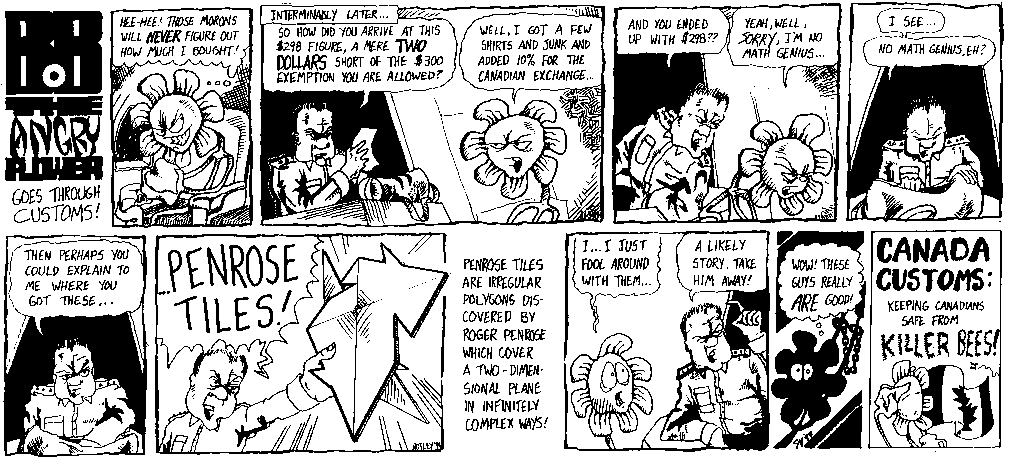
the cartoon Bob the
Angry Flower Goes Through Customs!
I'm pretty happy with the quality of the slides I created to demonstrate
the aperiodic tile sets I discussed.
Here's a PDF of the slides to refresh your memory and in case anyone
out on the web can use them for teaching. Of course, when I make slides
I just put the pictures on them, and speak from notes. No bulleted
lists here!
-
As a warm-up, I start with Robinson's aperiodic set R1 of
six tiles. I prove they must assemble into 3x3 blocks in
a fixed set of ways, then suggest how this process may be
carried out for ever larger square blocks of tiles. I also
say briefly why all these tilings must be nonperiodic.
The payoff is the observation that the protusions on the
tilings can be interpreted as an infinite hierarchy of
overlapping suqares of different sizes.
-
I the proceed to Penrose's first aperiodic set, P1. I
show how the deflation process works. Presumably, deflation
can be carried out an infinite number of times to tile the
whole plane. Is that so? At this point we truly need some
extra machinery to explain how that could be possible. Therefore,
I invoke the extension theorem from Chapter 3 of
Tilings and Patterns. The extension theorem is like
a theorem about limits: if a set of tiles admits arbitrarily
large patches of tiles, then it tiles the whole plane. If
anything deserves to be called the "fundamental theorem of
tilings", this seems like a good candidate.
Because this process can be carried out in reverse (tiles
can be grouped together and recomposed into large copies of
themselves in a unique way), we can argue that any tiling by
P1 is necessarily nonperiodic.
It's worth reading Penrose's informal article
Pentaplexity, which explains his inspiration for P1.
- From P1 I move to P2 (kites and darts), and P3 (thin and thick
rhombs). I discuss the aperiodicity of these two sets, and
outline one of my favourite proofs from tiling theory: tilings
from P2 must be nonperiodic, because the limit of the ratio of
kites to darts goes to the golden ratio as you repeatedly deflate.
But this ratio must be rational for any periodic tiling!
- As Grünbaum and Shephard point out, the matching conditions
on P2 and P3 (and P1 for that matter) can be represented by
suitably chosen edge shapes. I use that fact in my research
to do Escherization on Penrose tilings. The results are of
low quality -- it's hard to get good shapes out of P2 and P3.
The necessary parameterizations are given in Section 4.6.4
of my thesis.
You can also play with a
Java
applet I wrote for manipulating Penrose tile shapes.
- There are many wonderful ways to draw a patch of Penrose tiles.
Simply putting down a tile and attaching tiles to it is likely
to run up against an inconsistency eventually; your drawing
algorithm needs to be global. The deflation rules for P2
provide a good way to do this. In preparing this lecture,
I realized that you can apply the deflation rules very easily,
without worrying about overlaps at all -- each tile produces
two darts under deflation, and you simply keep the left-hand
one. This is much simpler than any other technique I've
implemented in the past.
- I finished up with some decorative applications of Penrose tiles.
There are a few more that I want to show but don't have images
for, or want to show but only after introducing more math.
There is a great deal of potential for the ornamental use of Penrose
tiles.
- In discussing aperiodic tilings, we got from the original
20426 tiles down to a set of two that tile only nonperiodically.
The natural question is whether a single shape can be an
aperiodic tile set. Very little is known about this problem,
which I recommend as a wonderful unsolved problem in geometry.
It's fairly easy to see that such a shape exists in 3D.
Lecture 12: Further properties of Penrose tiles
Penrose's aperioric sets have so many interesting mathematical
properties that I can't resist demonstrating some of them. We
can either view these as useful properties that might yield
decorative applications, or maybe as attractive mathematical facts
in and of themselves.
- I basically cover Section 10.5 of Tilings and Patterns,
which demonstrates the local isomorphism property of P2 via
the Cartwheel tiling. We cover the following facts about P2
(which pretty much carry over to the other Penrose sets too):
- Inflation preserves symmetries of patches of tiles.
- Except for an anomalous patch of seven tiles at the
centre, every tile in the cartwheel tiling is contained
in a patch with d5 symmetry.
- In every tiling by kites and darts, every point in the
plane is contained in an ace (one of the seven vertex
configurations that can occur in P2 tilings.
- In every P2 tiling, every tile lies in a cartwheel of
every size.
- Any arbitrarily large patch of tiles that occurs in a P2
tiling occurs infinitely often in every P2 tiling.
- I show two remarkable methods for generating P3 tilings by thin
and thick rhombs. For the first one, observe that the rhombs
in any P3 tiling line up into five distinct families based on
edge directions. These families can be summarized by five
families of parallel lines. Note that the spacing of the
lines is given by a "Fibonacci sequence", a kind of nonperiodic
tiling of the line.
- What's amazing is that the reverse
is true as well: given five evenly-spaced families of parallel
lines, you can construct the dual (in the sense of the overlay
tilings of Lecture 10) and get a P3 tiling. De Brujin called
this the "pentagrid method". Jie found an excellent
recent article by Robert Austin that shows all these
properties very effectively.
- Finally, I talk about the "lattice projection" method.
In this method, you slice through a high-dimensional integer
lattice and project features of the lattice down onto the cutting
hyperplane orthogonally to produce tiles. When the cutting plane
is oriented just so, the result is a nonperiodic tiling. This
is the method demonstrated by
Quasitiler
(the online application doesn't work, but the
website still contains a lot of information). I also discovered
that someone had reimplemented Quasitiler in the context of a
Java-based screensaver. Be sure also to see Greg Frederickson's
web page about his
rhombic coffee table, which is related to P3.
- For more information on the algebra of Penrose tilings, see
Marjorie Senechal's book Quasicrystals and Geometry.
Lecture 13: Euclidean and non-Euclidean geometry
Because I retain my love for the pure math I did as an undergrad, I
spare no expense in presenting a formal treatment of geometry on the
way to a practical system for Euclidean and non-Euclidean geometry.
Almost all of the first part of this lecture is taken from the opening
chapters of Marvin J. Greenberg's book Euclidean and Non-Euclidean
Geometries: Development and History (W.H. Freeman, 1993). This is
a wonderful book that I heartily recommend to anyone with an interest
in geometry or the history of mathematics. The book intersperses the
math with chapters on history and philosophy, and includes biographical
information about the sometimes curious personalities of those involved
in the discovery of non-Euclidean geometry. As always, a very brief
summary can be found at the very start of Chapter 2 of my thesis.
- I open by stating Euclid's postulates (expressing the parallel
postulate in its familiar modern form as Playfair's postulate).
I use this as a way to say what the problems were that led
people to study Euclid's work more carefully with the tools
of "modern" mathematics. I point out that the terms "point"
and "line" are best left simply undefined (Euclid provided
rather fanciful definitions that don't add any rigour). Also,
the relationships of "incidence", "betweenness" and "congruence"
can be left undefined; their behaviour will be constrained by
the axioms.
- If all these things are undefined, how do we know what we're
talking about? We can do math formally, but Euclid clearly had
a mental picture of an infinite 2D plane when he gave his axioms.
In modern terms, we speak of specifying an interpretation
for a formal system in which the undefined terms are concrete
spaces and relations, and the axioms are statements. If the
axioms are indeed true statements in the interpretation, that
interpretation is called a model.
- Models tell us a lot about formal systems. I give two examples.
- Say you have two formal systems F and G, and
G is a model for F. If you believe in the
consistency of G, you must then believe in the
consistency of F, for any inconsistency in F
could be passed through the model and become a proof of
G's inconsistency! This is called relative
consistency.
- Say you have a formal system F and some statement
s that you want to show is provable from F.
If you exhibit a model of F in which s is
false, then it can't be provable in the formal system!
Similarly, a model of F in which s is true
shows that its negation is not provable. If both models exist,
s is said to be independent of F.
- There are lots of models of Euclidean geometry as Euclid
described it. The empty set of no points satisfies the postulates,
as do lots of simple toy geometries that can be drawn as graphs
(Greenberg gives some good exmaples). The model we're familiar
with is the real Cartesian plane with coordinates consisting of
two-tuples of real numbers. But Euclid's postulates don't force
that to be the only model, even though that's what he had in mind.
Many mathematicians, most notably Hilbert, offered more rigorous
treatments of Euclidean geometry in which all possible models are
isomorphic. Such a formal system is called categorical.
- For a long time, the parallel postulate was thought to be
provable from the other four. In the nineteenth century, it was
shown that you can accept a negation of the parallel postulate and
arrive at a consistent geometry called hyperbolic or Lobachevskian
geometry. It was proven (relatively) consistent by exhibiting
a model (the Beltrami-Klein model) within Euclidean geometry.
- If you take (Hilbert's presentation of) Euclidean geometry and
leave off the parallel postulate altogether, you get neutral
geometry, in which you can say all true things about Euclidean
or hyperbolic geometry as long as you don't make any assumptions
about parallel lines. It seems natural to incorporate spherical
geometry into this development, but that's not possible. The
sphere doesn't play nicely with betweenness, and in any case you
can prove in neutral geometry that parallels do exist (they don't
on the sphere). But it's possible to reformulate the axioms of
geometry to avoid this incompatibility. In
College Geometry (Holt, Rinehart and Winston, 1969),
David Kay presents Birkhoff's ruler-and-protractor
postulates, massaged so that you can tack on any of the three
possible parallel postulates at the end and obtain a consistent
geometry.
- We're quite comfortable with the Cartesian plane as a model for
Euclidean geometry, and it's not too much of a stretch to visualize
the sphere as a model of spherical geometry (not elliptic
geometry; in spherical geometry points are single points on the
sphere and lines are great circles). There are several models of
hyperbolic geometry, all of which have different uses.
- The Minkowski hyperboloid model (or the Lorentz model)
uses the upper sheet of a hyperboloid of one sheet defined
by the equation x2 + y2
- z2 = -1. Lines are the intersections
of the hyperboloid by planes through the origin of 3D space.
This model is convenient for representing rigid motions,
which turn out to be expressible as 3x3 matrices. It's
therefore useful for drawing symmetric pictures in the
hyperbolic plane.
- In the Beltrami-Klein model, points lie in the interior
of a disk in the Euclidean plane. Lines are chords of
the disk (including diameters). Obviously, we don't
use Euclidean distance to measure the hyperbolic distance
between two points. The advantange of this model is that
it's projective -- straight hyperbolic lines are represented
by straight Euclidean lines. Thus incidence and betweenness
are easy to visualize, and many geometric computations
become very simple. A potential disadvantage is that
it's not very numericallly stable, since most information
is packed near the boundary of the disk.
- The final useful model is the Poincaré disk model.
Again, points lie in a disk. Lines are now represented
by circular arcs that cut the disk at right angles (including
diameters). Lines are no longer straight, but the
Poincaré model is conformal: the Euclidean angle
between two arcs is equal to the angle between the
corresponding hyperbolic lines. In some sense, this makes
is most suitable for representing "shapes" accurately in
ornamental contexts. Most computations are difficult in
this model, so it's best to stick it at the end of a
hyperbolic graphics pipeline.
- If you take Kay's axioms without the parallel postulate, you
can say anything that's true in the Euclidean plane, the hyperbolic
plane, or the sphere. We call this formal system absolute
geometry.
Any theorem of absolute geometry is automatically true in all
three sub-geometries. More importantly, if you construct some
shape or design using only theorems of absolute geometry, you
automatically get three separate pictures. Absolute geometry
can be a bit hard to visualize, because there's no good model
that captures only the true facts about it. All the models we've
seen are automatically models of absolute geometry, but they're
misleading because they all enforce some behaviour for parallels.
Furthermore, we have to work with undefined concepts. I know
that I can measure distances in absolute geometry, even if I can't
tell you what the distance function actually is -- that's a
property of the model.
- None of these conceptual problems pose any difficulty in an
implementation of absolute geometry. An implementation can follow
the familiar object-oriented paradigm. The formal system with
its axioms and theorems becomes an abstract interface, and the
models become implementations of that interface. At runtime,
we can substitute different models to get the same construction
in different planes. I suggest a Java-like approach using
subclassing, and a C++-like approach using template specialization.
The latter is explained in more detail in my thesis.
- I give a definition for equidistant curve, and then use
that to build an absolute trigonometry, which allows us to
identify the relationships between triangles in absolute geometry
(again, we can do this even if we don't know how to define the
functions). De Tilly defines two functions: Circle(x) (represented
typographically with an actual circle) and E(x). In practice, they
can be defined case-by-case for Euclidean, hyperbolic, and spherical
geometry. We can then use these two functions to derive trig
identities for generic and right-angled triangles in absolute
geometry. Remarkable stuff.
Lecture 14: Islamic star patterns
The Islamic decorative tradition spread quickly with
the rise of Islamic rule in the ninth and tenth centuries. Today,
remnants of that tradition can be found across southern Europe, northern
Africa, the Middle East, India, and western Asia. Small pockets of
artisans continue to practice Islamic art on a smaller scale.
One of the best known varieties of Islamic art are Islamic star patterns,
abstract geometric arrangements of stars and other shapes. In this
lecture, I discuss some techniques for producing and decorating star
patterns. Much of this discussion comes from
my own
work. I also highly recommend the following references.
- Jay Bonner is an
architectural ornamentalist who has contributed designs to some
of the most important monuments of Islam. His website includes
many examples of star patterns. His work has documented some
remarkable star patterns with unusual combinations of stars.
- Dover publishes the plates from Bourgoin's Arabic Geometrical
Pattern & Design. There are many important flaws in
Bourgoin's drawings and his construction lines are suspect, but
this is still a classic reference.
- The book Arabic Art (L'Aventurine) is a collection of
plates from L'Art arabe d'après les monuments du Kaire
by Achille Constant Théodore Emile Prisee d'Avennes (!).
The drawings by Prisse d'Avennes are exquisite, and are an
opportunity to glimpse back through time at Islamic art and
architecture of the late 19th century.
- Jean-Marc Castéra's Arabesques: Decorative Art in
Morocco is an excellent reference with drawings and photographs
that explain the Moroccan style of star pattern design (more on
that in the next lecture).
Many other references can be found through obvious web searches or by
looking through the citations in Chapter 3 of my thesis.
Here are the specific topics I covered.
- After some brief history and examples, I explain (my interpretation
of) Hankin's polygons-in-contact technique. Given a tiling, we
extend rays from the centre of every edge until they intersect other
rays. The whole process is controlled by a single real-valued
parameter I call the "contact angle", the angle formed by rays with
the tile edges from which
they start. There are many other smaller details required to make
this approach robust. They are given in
a paper of mine.
- Once this process is defined, we can construct what I call
"Islamic parquet deformations" by varying the contact angle
continuously in space.
- Many star patterns feature rosettes, where stars are
surrounded by irregular pentagonal arms in a characteristic way.
I show two ways to construct rosettes. The first is explicit:
in A.J. Lee's paper "Islamic Star Patterns" (Muqarnas 4, 1987),
he gives a compass-and-straight-edge construction for rosettes
inside regular polygons. In my earlier Taprats technique, I
parameterize this construction to make available a family of
rosette-like shapes. You can
play
with Taprats as a Java applet or downloadable application.
- The other way to get rosettes is to embed their structure into
the underlying tiling. In my "polygons-in-contact" paper, I
show that tilings that produce rosettes can be derived from simpler
tilings through a transformation I call the "rosette dual".
We are now left with the choice of giving the artist explicit
control over rosette shapes, or giving them a smarter collection
of tilings and a single design parameter. Over time, I've become
more enthusiastic about the latter approach.
- We are left asking where good tilings come from in the first
place. To construct insteresting star patterns, we should identify
tilings that contain many regular polygons, but which may also
contain other irregular shapes. In my paper "Islamic Star Patterns
in Absolute Geometry", I give one possible construction technique.
We place regular polygons around rotational centres of a symmetry
group, scale them until they meet each other, and fill the remaining
space with tiles.
- But now observe that nothing in the polygons-in-contact technique,
the rosette dual, or the tiling construction relies on parallelism.
Islamic star patterns could then be constructed equally easily
in the Euclidean plane, the hyperbolic plane, and the sphere.
In my work, I use an abstract library that lets me express the
construction using the axioms of absolute geometry, so that
the different Euclidean and non-Euclidean versions can then be
produced "for free".
- The lecture ends with a bunch of examples of Euclidean and
non-Euclidean star patterns. Some are simply rendered, and
some are constructed using various computer-aided manufacturing
techniques. Star patterns serve as a good example of how the
computer can be used as part of the construction of ornamental
objects. Ornament, which had been marginalized because of the
twentieth-century popularity of modernism, has an opportunity to
regain acceptance.
Lecture 15: Geometry and Islamic art wrap-up
The previous lectures wove together many threads having to do with
non-Euclidean geometry and Islamic art. In this lecture I draw those
threads together and try to provide some closing remarks for each.
The lecture can be broken down roughly into three components: "further
results on Islamic star patterns", "other forms of Islamic art", and
"other artistic uses of non-Euclidean geometry".
- Further results on Islamic star patterns
- The paper "Interlace patterns in Islamic and Moorish art"
by Grünbaum and Shephard (Leonardo 25(1992)) provides
an analysis of star patterns according to the restriction of
a star pattern to its fundamental region. Using the fundamental
region, it is possible to determine the number of transitivity
classes of strands in a pattern, the symmetry groups of the
strands, whether they are closed or infinite, and the number
of crossings strands make with each other. This is very
much an analysis technique -- no prescription is given for
producing new star patterns.
- In The Tinkertoy Computer, A.K. Dewdney presents a
method for star pattern construction based on reflecting lines
off of a regularly-placed grid of circles. This process can
produce a useful class of star patterns, though Dewdney
admits that many of the steps require significant intuition
and intervention. François Dispot's
Arabeske Studio
is a fully featured Java applet that implements this technique.
- Jean-Marc Castéra's
approach to star patterns is
based on the Moroccan tradition and is quite different than
what appears above. He more explicitly recognizes the
individual shapes produced in star pattern design (this is
consistent with physical construction by small terracotta
tiles, a technique known as Zellij). His
patterns tend to use a coarse "skeleton" of |8/3| stars
("seals of Solomon") and irregular hexagons ("safts"). The
spaces in the skeleton are then filled by more shapes.
The pattern is usually centered around a single, many-pointed
star (with as many as 96 points) instead of a periodic pattern.
- Other forms of Islamic art
- There is an important tradition of stylized floral design in
Islamic art. Some examples appear in The Grammar of
Ornament. Jay Bonner has developed his own unified
Islamic floral style and has used it in his architectural
work (for example, the
minbar
of the Ka'aba).
- Muqarnas are an idiosyncratic form of Islamic architectural
ornamentation. They are a collection of small elements that
act as corbelling, smoothing the transition from a ceiling or
a dome to a wall. The appearance of a muqarnas vault is
somewhere between a jewel and a cave full of stalactites.
- Islamic artisans were some of history's greatest calligraphers.
There are many different styles of Arabic calligraphy. Some
are free flowing and can even be arranged into animal form.
The most intriguing to me is square kufic, in which words are
jammed into rigid square grids. Because I can't read Arabic,
it's hard for me to get a sense of how immediately readable text
is when set in this style. I've been told it's a bit of a
visual puzzle to native readers.
- Other artistic uses of non-Euclidean geometry
- Tony Bomford was a surveyor for the Australian government.
He also produced some hooked rugs depicting hyperbolic
tessellations.
Doug Dunham
has written a couple of
papers on the
subject.
- Helaman Ferguson
has incorporated non-Euclidean geometry into several sculptures,
and even produced a hyperbolic quilt.
- Irene Rousseau has created some tile mosaics of the
hyperbolic plane.
- Doug Dunham is the master of all things hyperbolic. He writes
papers that adapt traditional Euclidean ornamental designs to
the hyperbolic plane in a way that's compatible with the symmetries
of the original. Most recently, he studied Escher's
Circle Limit III and showed how to derive other
hyperbolic arrangements of fish with similar properties.
- Carlo Séquin and Jane Yen created an interactive tool
for designing and manufacturing spherical Escher tilings.
They used their
Escher Sphere Construction Kit to reproduce some of Escher's
original carved wooden spheres, some spherical adaptation of
his work, and some new original tilings. They print their
designs as a single unit on a Z-Corp starch printer or in pieces
on a plastic FDM machine. In the latter case, they choose the
radius of the sphere so that the pieces can be glued around a
tennis ball!
- Jos Leys has experimented
with many different applications of symmetry and geometry to
computer imagery. He recently explored many
hyperbolic
tessellations, some adapted directly from Escher and some
newly created.
Lecture 16: Polyhedra
Polyhedra have long been an important part of mathematical art. We
could argue that they don't belong in the same group as other kinds of
ornament because they are 3D objects in and of themselves. But polyhedra
have many properties in common with planar ornament because of their
connection to spherical geometry. And they appear repeatedly in some
of the same contexts. So we'll study them in this course. The first
and ultimate reference for all things polyhedral is
George Hart's website. It
also includes links to other useful sites. Other consistently useful online
sources of information are Wikipedia
and Mathworld.
- I start with some history, including lots of old images of
polyhedra. The slides were taken from one of the lectures in
George Hart's Computer
Science and Sculpture course.
- I define and discuss properties of some basic polyhedra: the Platonic
solids, the Archimedean solids, the Catalan solids, and the
Johnson solids. There are some nice tricks for finding coordinates
for the vertices of the Platonic solids. Two tetrahedra can be
inscribed in the vertices of a cube; the vertices of an icosahedron
form three mutually perpendicular golden rectangles.
That the Archimedean polyhedra resemble the Archimedean
- A topic close to my heart is near misses: convex polyhedra
that are nearly, but not quite, Johnson solids. This is very
much an open area of inquiry. What are all the near misses? For
that matter, can we even furnish a reasonable definition of them?
Perhaps there's some kind of measurement of the closeness of a
polyhedron to Johnsonhood, and an acceptable cutoff below which
solids can be considered near misses. Jim McNeill has
a
page that describes some near misses, and I have
my own page with a few more.
There are many other systems of polyhedra that yield attractive
shapes. Some feel more "classification based": define a set of
properties that your polyhedra should have, and find a way to determine
all polyhedra that satisfy those properties. Other techniques are
more "notation based": define an open-ended notation where strings
produce polyhedra, and search for interesting examples.
- Uniform
polyhedra are like Archimedean solids: the vertices form a
single transitivity class under the polyhedron's symmetries.
But we relax the restrictions that the solid must be convex (allowing
self-intersections) and that the faces must be convex (allowing
star faces and "star vertices").
-
Symmetrohedra are a construction technique closely related
to my tiling construction technique for Islamic star patterns.
(In fact, they were a first test of the general absolute geometry
approach). Regular polygons are "threaded" onto the rotational
axes of a polyhedral symmetry group until they mate with one another.
Then take the convex hull. Many new and interesting polyhedra
are produced.
- Conway notation is a symbolic method for describing symmetric polyhedra
as a sequence of topological transformations on an initial, primitive
polyhedron. George Hart uses Conway notation to produce interesting
sculptures. The big difficulty with Conway notation is in deciding
on the "right" polyhedron with a given topology. A theorem by
Koebe, Andreev and Thurston guarantees that a "canonical polyhedron"
exists, but gives no prescription of how to compute it. Finding
a numerical technique for constructing canonical polyhedra would be
a very interesting research question.
- Stellation
is a generalized process of erecting new "spikes" on top of the
faces of an underlying convex solid. Consider a single face plane
of a convex polyhedron. Intersect it with all the other face planes
to produce a stellation diagram. Selectively enabling parts
of that stellation diagram leads to potentially large collections
of new solids, depending on the original polyhedron. For example,
the cube and tetrahedron have no stellations, the octahedron
has one (the stella octangula), the dodecahedron has three,
and the icosahedron has 58. The rhombic triacontahedron has hundreds
of millions!
A good online tool for playing with stellations is
Vladimir Bulatov's Java applet.
Robert Webb's
Stella is pretty much the definitive tool these days. It can
draw stellations and many other kinds of polyhedra, and includes
great tools like the ability to generate a net.
George Hart has written some great papers about how he uses
stellation diagrams as a basis for placing congruent elements in
a kind of tangled polyhedral sculpture. See, for example, his
paper "
Sculpture from symmetrically arranged planar components".
- Compounds are overlapping symmetric arrangements of polyhedra.
As far as I know, there is no general theory of compounds, so the
search for new models is open ended. One systematic approach is
to look at polyhedra with many vertices and partition those vertices
into multiple copies of the vertices of simpler polyhedra. It's
easy to fit two tetrahedra into a cube this way, or five tetrahedra
into a dodecahedron. But many compounds are much more sophisticated.
Magnus Wenninger,
a Benedictine monk and mathematical enthusiast, has built many
beautiful compounds. George Hart
index of VRML models contains many examples of compounds (alas,
you need a working VRML viewer to see them).
- There's a nice metalwork sculpture of an elevated small truncated
rhombicuboctahedron in Al Madina.
Lecture 17: Projections of polytopes, polyhedral wrap-up
Polytopes are the generalizations of polyhedra to any number of dimensions,
though the term is sometimes used to refer specifically to four dimensions.
It's worth taking a look at some properties of 4D polytopes and how we
might construct representations of them in 3D.
Most of the images and slides used in this lecture come directly from the
"Four-dimensional forms" lecture in George Hart's
computer science and
sculpture course. Also worth checking out are
Bathsheba Grossman's website
(click on "math models", for example) and David Richter's page of
Zome projects.
Web searching can locate many other amazing examples of Zometool sculptures.
- We can enumerate the ordinary Platonic solids via a simple
argument about face angles around a vertex. Similarly, we can
enumerate the regular polytopes in 4D my measuring dihedral
angles of cells around an edge. There are
six regular 4D polytopes. In all higher dimensions, there are only three.
- Just as we use laws of geometry to draw 2D renditions of
3D polyhedra, we can create 3D shadows of 4D polytopes. We
can use orthographic or perspective projection, and orient
the polytope in a number of different ways. Often we orient
and project in such a way that many elements overlap in 3D
space (by analogy, an orthographically projected cube may
resemble a square). That's okay -- we still get interesting
mathematical sculptures.
- Zometool is a wonderful
toy for exploring geometry, especially projections of 4D polytopes.
With enough Zometool parts available, some
incredible sculptures can be produced.
- To finish, I show many examples of 20th century polyhedral
sculpture, mostly taken from George Hart's slides (and including
many of his own works).
Lecture 18: Remapping the plane
Once you have created an attractive 2D pattern in the plane, there are
still some things you can do to it to increase its appeal. One possibility
is to define a transformation of the plane and pass the design
through that transformation. For more information on this topic, see
Robert Dixon's book Mathographics or his paper "Two Conformal
Mappings" from the journal Leonardo.
- Rigid motions and similarities are certainly valid transformations
of the plane, but they're not interesting in this context because
they really don't "do anything". All along, we've been basing
our concept of congruence on rigid motions, so translating and
rotating an object doesn't change it in any useful way. Scaling
potentially is a little more interesting in non-Euclidean geometry.
Collineations, which preserve straightness, are also more interesting,
but they also can't be forced to really change a picture. They
correspond roughly to tilting and foreshortening the plane in 3D,
and our perceptual systems correct for that too easily.
- It's more exciting to investigate conformal maps, which only
preserve angles. As with our discussion of the Poincaré
model of hyperbolic geometry, we can argue that conformal maps
do a reasonable job of preserving shape. However, there is a
much wider variety of non-trivial conformal maps. Many arise by
treating the plane as a complex plane and considering functions
that map complex numbers to complex numbers.
- Circular inversion reciprocates every point in the plane along
a radius of a given circle. It swaps the interior and exterior
of the circle, and exchanges the centre of the circle with the
point at infinity. It turns a periodic pattern into a pattern
that diminishes in size to a limit point at the centre of the circle.
Circular inversion forms the basis of the geometry of the
Poincaré disk, and provides the connection between the
disk and the half-plane model (via an inversion in a circle
tangent to the half-plane). Circular inversion pops up occasionally
as a kind of fractal. George Hart
suggests it
as a way to produce
interesting sculptures by inverting polyhedral arrangements in
spheres.
- Another wonderful transformation of the plane is the Anti-mercator
projection. It can be expressed as exponentiation in the complex
plane. This function transforms a horizontal stripe of width
2π to a radial picture that takes up the whole plane. Horizontal
lines become radial lines; vertical lines become circles;
general lines become logarithmic spirals. Anti-mercator projection
works very well with periodic patterns, as long as they're moved
so that the vertical vector of length 2π is a translational
symmetry of the original pattern. Escher used this projection
several times in his work, for example in Snakes (his last
print) and Butterflies.