Fast arithmetic mod 2^32, including gcd. More...
#include <local2_32.h>
 Inheritance diagram for Local2_32: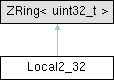
Public Types | |
| enum | Exponent { _min =0 , _max =32 } |
| typedef Givaro::ZRing< uint32_t >::Element | Element |
Public Member Functions | |
| Local2_32 (int p=2, int exp=32) | |
| Element & | gcd (Element &c, const Element &a, const Element &b) const |
| Element & | gcdin (Element &b, const Element &a) const |
| Exponent & | gcdin (Exponent &k, const Element &b) const |
| bool | isUnit (const Element &a) const |
| bool | isUnit (const Exponent &a) const |
| bool | isZero (const Element &a) const |
| bool | isZero (const Exponent &a) const |
| Element & | mulin (Element &a, const Exponent &k) const |
| Element & | mulin (Element &a, const Element &b) const |
| Element & | axpyin (Element &r, const Element &x, const Element &y) const |
| Element & | divin (Element &a, const Exponent &k) const |
| Element & | inv (Element &a, const Element &b) const |
Static Public Member Functions | |
| static integer | maxCardinality () |
Protected Member Functions | |
| Element & | xgcd (Element &d, Element &s, Element &t, const Element &a, const Element &b) const |
| Element & | HGCD (Element &g, Element &s, const Element &a, const Element &b) const |
| Half GCD g = gcd (a, b). | |
Detailed Description
Fast arithmetic mod 2^32, including gcd.
Extend Givaro::ZRing<uint32_t> which is a representation of Z_2^32. It is especially fast because it uses hardware arithmetic directly. This ring is a Local Principal Ideal Ring.
These needed PIR functions are added: gcdin(), isUnit(), also inv() is modified to work correctly. The type Exponent is added: more effective rep of the powers of 2, which are important because gcds are powers of 2). This entails some new versions of divin(), mulin(), isUnit().
Those are the function needed for the LocalSmith algorithm. Further appropriate PIR functions may be added later.
- Examples
- examples/smith.C.
Member Typedef Documentation
◆ Element
Member Enumeration Documentation
◆ Exponent
| enum Exponent |
Constructor & Destructor Documentation
◆ Local2_32()
|
inline |
Member Function Documentation
◆ gcd()
◆ gcdin() [1/2]
◆ gcdin() [2/2]
◆ isUnit() [1/2]
|
inline |
◆ isUnit() [2/2]
|
inline |
◆ isZero() [1/2]
|
inline |
◆ isZero() [2/2]
|
inline |
◆ mulin() [1/2]
◆ mulin() [2/2]
◆ axpyin()
◆ divin()
◆ inv()
◆ maxCardinality()
|
inlinestatic |
◆ xgcd()
|
inlineprotected |
◆ HGCD()
|
inlineprotected |
Half GCD g = gcd (a, b).
exists t, such that: s * a + t * b = g. return g.
The documentation for this struct was generated from the following file:
Generated on Fri Jan 16 2026 00:40:06 for linbox by
 1.13.2