#include <gmp-rational.h>
 Inheritance diagram for GMPRationalField: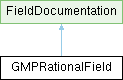
Public Member Functions | |
Object Management | |
x <- convert (y) | |
| GMPRationalField (const GMPRationalField &) | |
| Copy constructor. | |
| ~GMPRationalField (void) | |
| Destructor. | |
| GMPRationalField & | operator= (const GMPRationalField &) |
| Assignment operator. | |
| Element & | init (Element &x, const integer &y=0) const |
| Initialization of field element from an integer. | |
| Element & | init (Element &x, const integer &num, const integer &den) const |
| Copy constructor. | |
| Element & | init (Element &x, const int64_t &y) const |
| Copy constructor. | |
| Element & | init (Element &x, const uint64_t &y) const |
| Copy constructor. | |
| integer & | convert (integer &x, const Element &y=0) const |
| Conversion of field element to an integer. | |
| Element & | assign (Element &x, const Element &y) const |
| Assignment of one field element to another. | |
| integer & | cardinality (integer &c) const |
| is infinite (signified by -1 here) | |
| integer & | characteristic (integer &c) const |
| of the rationals is 0. | |
| integer | cardinality () const |
| Copy constructor. | |
| integer | characteristic () const |
| Copy constructor. | |
Arithmetic Operations | |
x <- y op z; x <- op y These operations require all elements, including x, to be initialized before the operation is called. Uninitialized field elements will give undefined results. | |
| bool | areEqual (const Element &x, const Element &y) const |
| Equality of two elements. | |
| Element & | add (Element &x, const Element &y, const Element &z) const |
| Addition. | |
| Element & | sub (Element &x, const Element &y, const Element &z) const |
| Subtraction. | |
| Element & | mul (Element &x, const Element &y, const Element &z) const |
| Multiplication. | |
| Element & | div (Element &x, const Element &y, const Element &z) const |
| Division. | |
| Element & | neg (Element &x, const Element &y) const |
| Additive Inverse (Negation). | |
| Element & | inv (Element &x, const Element &y) const |
| Multiplicative Inverse. | |
Inplace Arithmetic Operations | |
x <- x op y; x <- op x These operations require all elements, including x, to be initialized before the operation is called. Uninitialized field elements will give undefined results. | |
| bool | isZero (const Element &x) const |
| Zero equality. | |
| bool | isOne (const Element &x) const |
| One equality. | |
| bool | isMOne (const Element &x) const |
| MOne equality. | |
| bool | isUnit (const Element &x) const |
| Zero equality. | |
| Element & | addin (Element &x, const Element &y) const |
| Inplace Addition. | |
| Element & | subin (Element &x, const Element &y) const |
| Inplace Subtraction. | |
| Element & | mulin (Element &x, const Element &y) const |
| Inplace Multiplication. | |
| Element & | axpy (Element &r, const Element &a, const Element &x, const Element &y) const |
| axpy. | |
| Element & | axpyin (Element &r, const Element &a, const Element &x) const |
| axpyin. | |
| Element & | divin (Element &x, const Element &y) const |
| Inplace Division. | |
| Element & | negin (Element &x) const |
| Inplace Additive Inverse (Inplace Negation). | |
| Element & | invin (Element &x) const |
| Inplace Multiplicative Inverse. | |
Common Object Interface for a LinBox Field. | |
These methods are required of all LinBox fields. | |
| typedef GMPRationalElement | Element |
| element type. | |
| typedef GMPRationalElement * | Element_ptr |
| pointer to element type. | |
| typedef const Element_ptr | ConstElement_ptr |
| const pointer to element type. | |
| typedef GMPRationalRandIter | RandIter |
| Random iterator generator type. | |
| const Element | zero |
| element type. | |
| const Element | one |
| element type. | |
| const Element | mOne |
| element type. | |
Input/Output Operations | |
| std::ostream & | write (std::ostream &os) const |
| Print field. | |
| std::istream & | read (std::istream &is) |
| Read field. | |
| std::ostream & | write (std::ostream &os, const Element &x) const |
| Print field element. | |
| std::istream & | read (std::istream &is, Element &x) const |
| Read field element. | |
| GMPRationalField (int p=0, int exp=1) | |
| Print field. | |
| integer & | get_num (integer &x, const Element &y) const |
| get numerator. | |
| integer & | get_den (integer &x, const Element &y) const |
| get denominator. | |
| int | sign (const Element &x) const |
| sign. | |
| integer & | bitsize (integer &bs, const Element &q) const |
| Bitsize as sum of bitsizes of numerator and denominator. | |
| static int | maxCardinality () |
| max modulus. | |
Member Typedef Documentation
◆ Element
| typedef GMPRationalElement Element |
element type.
◆ Element_ptr
| typedef GMPRationalElement* Element_ptr |
pointer to element type.
◆ ConstElement_ptr
| typedef const Element_ptr ConstElement_ptr |
const pointer to element type.
◆ RandIter
| typedef GMPRationalRandIter RandIter |
Random iterator generator type.
Constructor & Destructor Documentation
◆ GMPRationalField() [1/2]
|
inline |
Copy constructor.
Vacuous, since this field is unparametric so there is no need to construct multiple field objects
◆ ~GMPRationalField()
|
inline |
Destructor.
Also vacuous, since there is no de-initialization system
◆ GMPRationalField() [2/2]
|
inline |
Print field.
- Returns
- output stream to which field is written.
- Parameters
-
os output stream to which field is written.
This does not do much...
Member Function Documentation
◆ operator=()
|
inline |
Assignment operator.
Also vacuous
◆ init() [1/4]
Initialization of field element from an integer.
Behaves like C++ allocator construct. This function assumes the output field element x has already been constructed, but that it is not necessarily already initialized. In this implementation, this means the _elem_ptr of x exists, but that it may be the null pointer.
- Returns
- reference to field element.
- Parameters
-
x field element to contain output (reference returned). y constant reference to integer.
◆ init() [2/4]
Copy constructor.
Vacuous, since this field is unparametric so there is no need to construct multiple field objects
◆ init() [3/4]
Copy constructor.
Vacuous, since this field is unparametric so there is no need to construct multiple field objects
◆ init() [4/4]
Copy constructor.
Vacuous, since this field is unparametric so there is no need to construct multiple field objects
◆ convert()
Conversion of field element to an integer.
This function assumes the output field element x has already been constructed, but that it is not already initialized. In this implementation, this means the _elem_ptr of y exists, and that it is not the null pointer.
Returns floor (numerator (y) / denominator (y))
- Returns
- reference to integer.
- Parameters
-
x reference to integer to contain output (reference returned). y constant reference to field element.
◆ assign()
Assignment of one field element to another.
This function assumes both field elements have already been constructed and initialized. In this implementation, this means for both x and y, _elem_ptr exists and does not point to null.
- Returns
- reference to x
- Parameters
-
x field element (reference returned). y field element.
FIXME: Is this x := y? I am assuming so.
◆ cardinality() [1/2]
◆ characteristic() [1/2]
◆ cardinality() [2/2]
|
inline |
Copy constructor.
Vacuous, since this field is unparametric so there is no need to construct multiple field objects
◆ characteristic() [2/2]
|
inline |
Copy constructor.
Vacuous, since this field is unparametric so there is no need to construct multiple field objects
◆ areEqual()
Equality of two elements.
This function assumes both field elements have already been constructed and initialized. In this implementation, this means for both x and y, _elem_ptr exists and does not point to null.
- Returns
- boolean true if equal, false if not.
- Parameters
-
x field element y field element
◆ add()
Addition.
x = y + z This function assumes all the field elements have already been constructed and initialized. In this implementation, this means for x, y, and z, _elem_ptr exists and does not point to null.
- Returns
- reference to x.
- Parameters
-
x field element (reference returned). y field element. z field element.
◆ sub()
Subtraction.
x = y - z This function assumes all the field elements have already been constructed and initialized. In this implementation, this means for x, y, and z, _elem_ptr exists and does not point to null.
- Returns
- reference to x.
- Parameters
-
x field element (reference returned). y field element. z field element.
◆ mul()
Multiplication.
x = y * z This function assumes all the field elements have already been constructed and initialized. In this implementation, this means for x, y, and z, _elem_ptr exists and does not point to null.
- Returns
- reference to x.
- Parameters
-
x field element (reference returned). y field element. z field element.
◆ div()
Division.
x = y / z This function assumes all the field elements have already been constructed and initialized. In this implementation, this means for x, y, and z, _elem_ptr exists and does not point to null.
- Returns
- reference to x.
- Parameters
-
x field element (reference returned). y field element. z field element.
◆ neg()
Additive Inverse (Negation).
x = - y This function assumes both field elements have already been constructed and initialized. In this implementation, this means for both x and y _elem_ptr exists and does not point to null.
- Returns
- reference to x.
- Parameters
-
x field element (reference returned). y field element.
◆ inv()
Multiplicative Inverse.
x = 1 / y This function assumes both field elements have already been constructed and initialized. In this implementation, this means for both x and y _elem_ptr exists and does not point to null.
- Returns
- reference to x.
- Parameters
-
x field element (reference returned). y field element.
◆ isZero()
|
inline |
Zero equality.
Test if field element is equal to zero. This function assumes the field element has already been constructed and initialized. In this implementation, this means the _elem_ptr of x exists and does not point to null.
- Returns
- boolean true if equals zero, false if not.
- Parameters
-
x field element.
◆ isOne()
|
inline |
One equality.
Test if field element is equal to one. This function assumes the field element has already been constructed and initialized. In this implementation, this means the _elem_ptr of x exists and does not point to null.
- Returns
- boolean true if equals one, false if not.
- Parameters
-
x field element.
◆ isMOne()
|
inline |
MOne equality.
Test if field element is equal to one. This function assumes the field element has already been constructed and initialized. In this implementation, this means the _elem_ptr of x exists and does not point to null.
- Returns
- boolean true if equals one, false if not.
- Parameters
-
x field element.
◆ isUnit()
|
inline |
Zero equality.
Test if field element is equal to zero. This function assumes the field element has already been constructed and initialized. In this implementation, this means the _elem_ptr of x exists and does not point to null.
- Returns
- boolean true if equals zero, false if not.
- Parameters
-
x field element.
◆ addin()
Inplace Addition.
x += y This function assumes both field elements have already been constructed and initialized. In this implementation, this means for both x and y _elem_ptr exists and does not point to null.
- Returns
- reference to x.
- Parameters
-
x field element (reference returned). y field element.
◆ subin()
Inplace Subtraction.
x -= y This function assumes both field elements have already been constructed and initialized. In this implementation, this means for both x and y _elem_ptr exists and does not point to null.
- Returns
- reference to x.
- Parameters
-
x field element (reference returned). y field element.
◆ mulin()
Inplace Multiplication.
x *= y This function assumes both field elements have already been constructed and initialized. In this implementation, this means for both x and y _elem_ptr exists and does not point to null.
- Returns
- reference to x.
- Parameters
-
x field element (reference returned). y field element.
◆ axpy()
|
inline |
axpy.
r = a*x + y
- Parameters
-
r a x y
◆ axpyin()
axpyin.
r += a*x
- Parameters
-
r a x
◆ divin()
Inplace Division.
x /= y This function assumes both field elements have already been constructed and initialized. In this implementation, this means for both x and y _elem_ptr exists and does not point to null.
- Returns
- reference to x.
- Parameters
-
x field element (reference returned). y field element.
◆ negin()
Inplace Additive Inverse (Inplace Negation).
x = - x This function assumes the field element has already been constructed and initialized. In this implementation, this means the _elem_ptr of x exists and does not point to null.
- Returns
- reference to x.
- Parameters
-
x field element (reference returned).
◆ invin()
Inplace Multiplicative Inverse.
x = 1 / x This function assumes the field elementhas already been constructed and initialized. In this implementation, this means the _elem_ptr of x exists and does not point to null.
- Returns
- reference to x.
- Parameters
-
x field element (reference returned).
◆ write() [1/2]
|
inline |
Print field.
- Returns
- output stream to which field is written.
- Parameters
-
os output stream to which field is written.
This does not do much...
◆ read() [1/2]
|
inline |
Read field.
- Returns
- input stream from which field is read.
- Parameters
-
is input stream from which field is read.
This does not do much either...
FIXME: Read the same thing written above, and throw an exception if the strings do not match.
◆ write() [2/2]
|
inline |
Print field element.
This function assumes the field element has already been constructed and initialized. In this implementation, this means for the _elem_ptr for x exists and does not point to null.
- Returns
- output stream to which field element is written.
- Parameters
-
os output stream to which field element is written. x field element.
◆ read() [2/2]
|
inline |
Read field element.
This function assumes the field element has already been constructed and initialized. In this implementation, this means for the _elem_ptr for x exists and does not point to null.
- Returns
- input stream from which field element is read.
- Parameters
-
is input stream from which field element is read. x field element.
FIXME: Avoid the magical limit on size here FIXME: Right now it skips over everything until it finds something that looks like a number. Is this really the correct policy?
aniau.nosp@m.@ast.nosp@m.ronet.nosp@m..pl: 06/2009: supports scientific E/e notation for decimal fractions
◆ maxCardinality()
|
inlinestatic |
max modulus.
◆ get_num()
get numerator.
- Parameters
-
x numerator of y y
◆ get_den()
get denominator.
- Parameters
-
x denominator of y y
◆ sign()
|
inline |
sign.
- Parameters
-
x
- Returns
- sign of
x
◆ bitsize()
Bitsize as sum of bitsizes of numerator and denominator.
- Parameters
-
bs q
- Returns
bs
Field Documentation
◆ zero
| const Element zero |
element type.
◆ one
| const Element one |
element type.
◆ mOne
| const Element mOne |
element type.
The documentation for this class was generated from the following file:
Generated on Fri Jan 16 2026 00:40:05 for linbox by
 1.13.2