2nd IEEE Big Data International Workshop on Software Engineering for Agentic AI (SE4AgenticAI 2026)
A Workshop of the 2026 IEEE International Conference on Big Data
December 14-17, 2026 - Phoenix, Arizona

Overview
- About the workshop
-
LLM agents increasingly collaborate and utilize external tools to address complex user requests. This emerging paradigm demands vast volumes of data for training, testing, reasoning, memory, and execution to ensure accurate and timely responses and actions. Despite the clear benefits, there remains a pressing need for a more rigorous characterization of software engineering constructs to effectively support LLM agents, particularly in areas such as orchestration, data management, knowledge augmentation, and planning. This workshop explores novel solutions to these challenges from the joint perspectives of software engineering and big data.
- Aims
-
The goal of this workshop is to bring together original, high-quality contributions on software engineering challenges and applied solutions for agentic AI and its synergy with big data, spanning architecture, development, verification, observability, agent-tool protocols, and resource management.
- Topics
-
Topics of interest include, but are not limited to:
- Agentic big data frameworks and systems.
- Requirements engineering for agentic systems.
- Design and architecture of LLM-based multi-agent systems.
- Development processes and data management in agentic systems.
- Code and other artifact generation assisted by software agents.
- Standardized agent-tool protocols (e.g., MCP, A2A).
- Human-in-the-loop in agentic systems.
- Conversational agents and chatbot frameworks.
- Structured and unstructured data manipulation for agentic recommender systems.
- Reproducibility and traceability of agentic systems development.
- Testing, verification, validation, and LLM-based multi-agent consensus mechanisms.
- Evaluation approaches and frameworks including LLMs as judges and LLM-based qualitative and quantitative metrics.
- Observability, accountability, audit trails, and reproducibility in LLM-based multi-agent systems.
- Empirical studies of multi-agent frameworks (e.g. LangChain, AutoGen, CrewAI).
- Domain-specific applications, including data science, spatial-temporal, and agentic recommender systems.
- Self-adaptation and other self-* properties in the context of agentic AI.
- Real-time or dynamic agentic execution, visualization, and workflows.
Submissions
- Call For Papers
-
We invite original research papers on Software Engineering for Agentic AI.
- Short papers: 3-4 pages, including references
- Regular papers: 8-10 pages, including references
- Important dates
-
- Submission deadline: October 10, 2026.
- Notification of paper acceptance to authors: October 31, 2026
- Camera-ready of accepted papers: November 14, 2026
- Workshop / conference dates: December 14 - 17, 2026
- Instructions
-
Use the submission system: https://wi-lab.com/cyberchair/2026/bigdata26/index.php
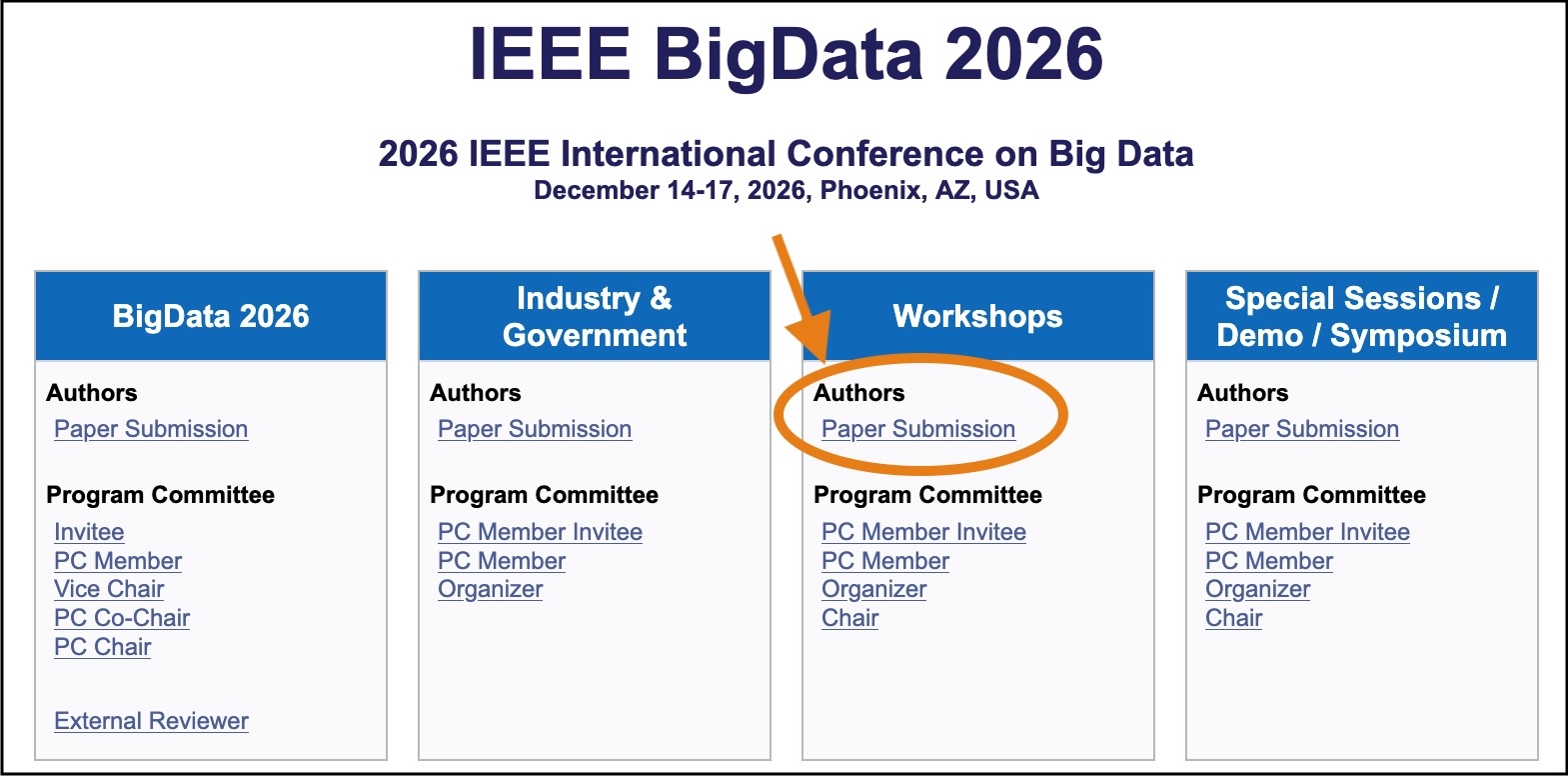
Steps:- Click on the Paper Submission link under Authors in the Workshop box.
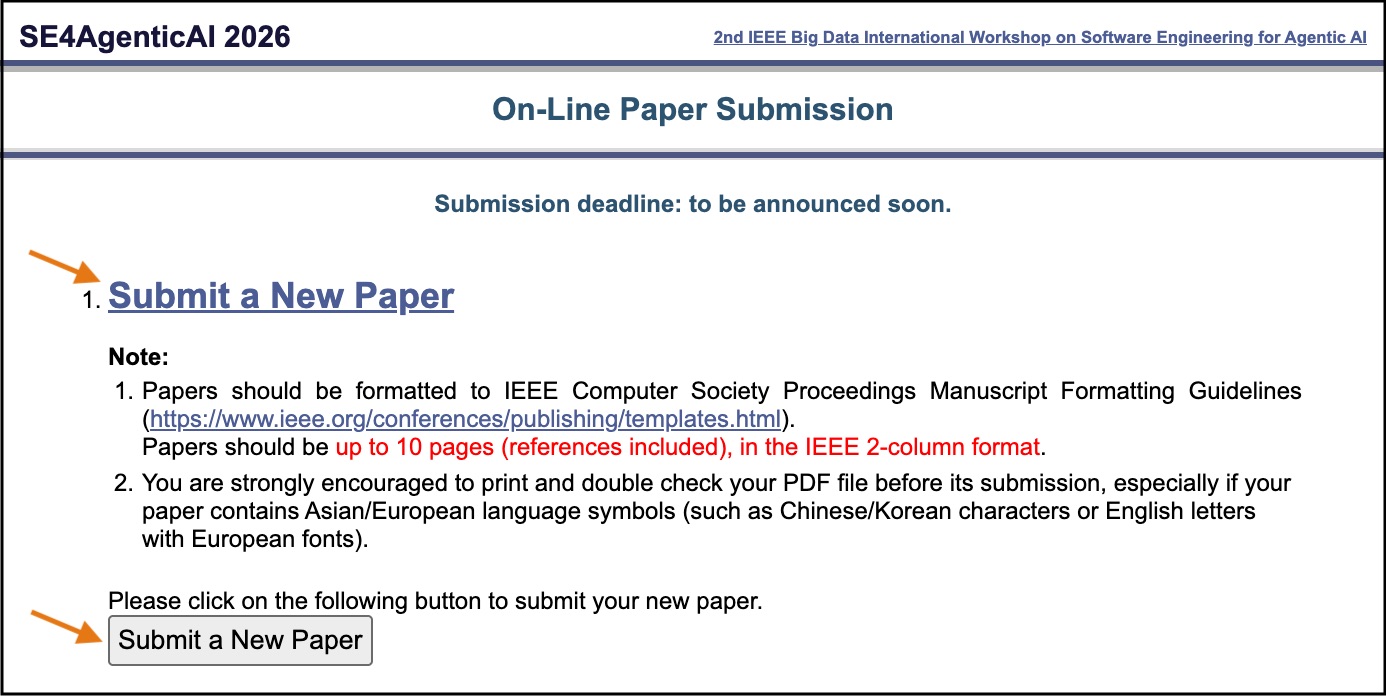
- Click on Workshop 59.
- Click on Submit a New Paper link or button and fill in the information about the paper.

- Schedule
-
To Be Announced.
Contact
- Organizers
-
- Tales Paiva: tmellopaiva@uwaterloo.ca
- Ivens: iportugal@uwaterloo.ca
- Paulo Alencar: palencar@uwaterloo.ca
- Donald Cowan: dcowan@uwaterloo.ca
- PC Members
-
- Alessandra Parziale, Gran Sasso Science Institute, Italy
- Abhishek Pandey, META, USA
- Aninditha Ramesh, DoorDash, USA
- Arpit Thool, Virginia Tech, USA
- Chandra Inguva, UC Berkeley, USA
- Dinesh Besiahgari, University of Cincinnati, USA
- Dhruv Patel, Independent Researcher, USA
- Enrico Vicario, University of Florence, Italy
- George Tambouratzis, Athena Research Center, Greece
- Giuliano Lorenzoni, University of Waterloo, Canada
- Hadi Hasan, American University of Beirut, Lebanon
- Ivan Compagnucci, Gran Sasso Science Institute, Italy
- Mahdi Ghadamyari, Google, USA
- Marc Maurer, Stealth AI Startup, USA
- Marco Torchiano, Politecnico di Torino, Italy
- Martin Mirchev, Eindhoven University of Technology, Netherlands
- Navaprasad Maram, Intuit, USA
- Nishant Ravi Shankar, Oracle, USA
- Praveen Myakala, JP Morgan & Chase, USA
- Rafael Kalandadze, Wandero AI, USA
- Sarita Kumari, Amazon, USA
- Satishkumar Masilamani, Intuiti, USA
- Stefano Lambiase, Aalborg University, Denmark
- Sumeet Ram, PayPal, USA
- Vikrant Bachhav, Condor Software, USA
- Yujun Zhao, META, USA
- Yunqing Li, Lenovo US, USA